
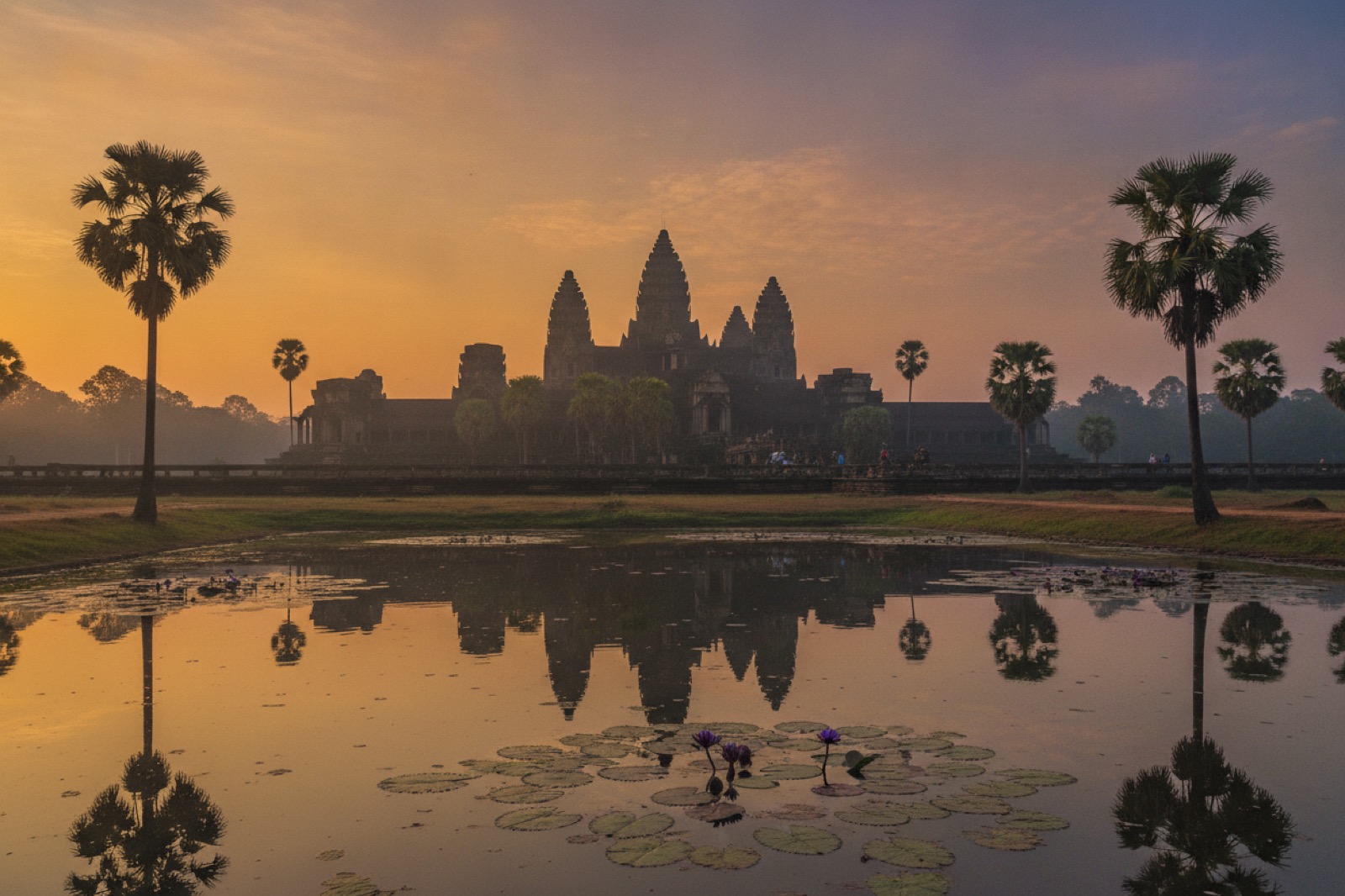
Angkor in 3 Days: A Siem Reap Itinerary
The small circuit at sunrise, the grand circuit and the pink temple of Banteay Srei, then the Tonlé Sap lake and the town — a practical three-day Siem Reap plan with Maps links, the right Angkor pass, budgets and the mistakes to avoid.
Siem Reap is the gateway to Angkor — the largest religious monument on earth and a sprawl of jungle-wrapped temples that reward more time than most people give them. Half a day won't do it justice; even the small circuit is a full, hot day, so two or three days is far better.
This three-day plan balances temples with the rest of Siem Reap: the headline small circuit (Angkor Wat at sunrise, the Bayon, Ta Prohm) on day one, the quieter grand circuit and the exquisite Banteay Srei on day two, then the great Tonlé Sap lake, the museum and the town on day three. Buy the right Angkor pass, start at dawn, dress modestly for the temples, and link every stop to Google Maps as you go.
At a glance
Your day-by-day Siem Reap route
A 3-day Siem Reap & Angkor route
Small circuit, the grand circuit with Banteay Srei, then a Tonlé Sap lake morning and the town — temples balanced with lake, museum and crafts.
Small circuit, then the grand circuit with the pink temple of Banteay Srei, then a Tonlé Sap lake morning and the town — temples balanced with lake, museum and crafts.
Day 1Small circuit — Angkor Wat, Bayon & Ta Prohm
- Angkor WatAngkor
- Beef lok lakCitywide
- Angkor Thom & the BayonAngkor
- Ta Prohm (jungle temple)Angkor
- Fish amokCitywide
- Pub Street & the night marketsOld Market
If it rains If a downpour hits, shelter in the Bayon's galleries and shift Ta Prohm later; the museum is a dry fallback.
Add if you have time A sunset at Srah Srang or Phnom Bakheng before dinner.
Day 2Grand circuit & Banteay Srei
- Num pang (Cambodian baguette)Citywide
- Preah KhanAngkor
- Srah Srang & Banteay KdeiAngkor
- Banteay KdeiAngkor
- Grilled river fish (trey aing)Citywide
If it rains Start Banteay Srei early; if the afternoon storms, swap the grand-circuit temples for the museum and the Phare circus stays dry.
Add if you have time A sunset from the Srah Srang landing.
Day 3Tonlé Sap lake, the museum & Khmer crafts
- Cambodian BBQ & soup (cha-hoy)Citywide
- Old Market (Psar Chaa)Old Market
If it rains The lake boat runs in the wet season (it's at its best then); if it's the low dry season or stormy, swap for a cooking class plus the museum and Artisans Angkor.
Add if you have time An apsara-dance dinner show, or the Phare circus if you missed it.
Route last checked 2026-06-21 — verify hours and bookings before you go.
Want this as an interactive guide you can reshape by length, budget and pace — with the maps, food and a one-tap PDF?
Get the Siem Reap Destination Pass · S$16.90 Or build a free planWhere to stay in Siem Reap
Siem Reap is small, so almost any central base works — and your money goes a very long way here: boutique hotels with pools sit at mid-range prices, and even luxury resorts are affordable. Stay walkable to the Old Market and Pub Street, or on a quieter riverside or Kandal Village street a short tuk-tuk away. Many hotels arrange your temple tuk-tuk and a free airport pickup.
Old Market / Pub Street
First-timers — walk to markets, restaurants and nightlife
Riverside / Wat Bo
Quieter, leafy boutique hotels minutes from the centre
Kandal Village / Sok San
Stylish design hotels and the café district
Charles de Gaulle (towards Angkor)
Resorts handy for early temple starts
By budget
- Budget — S$16–47 · Guesthouses & hostels, Pool guesthouses (great value)
- Mid-range — S$60–150 · Boutique pool hotels, 4-star hotels
- Comfortable — S$200–680+ · 5-star resorts & heritage hotels, Spa retreats
- A boutique hotel with a pool is astonishing value here — the perfect midday escape from the temple heat.
- Stay walkable to the Old Market for dinner; the temples are reached by tuk-tuk wherever you sleep.
- Ask your hotel to arrange the temple tuk-tuk and airport pickup — most do it cheaply and reliably.
Rates and availability change, and peak season (Nov–Feb) is dearer — confirm with the property or a booking site before paying.
What to budget for Siem Reap
Per person, per day, excluding flights. A rough guide only — your costs depend on season, area and pace.
Budget
- Accommodation: Pool guesthouse or hostel near the Old Market (US$12–35).
- Meals: Markets and local kitchens — nom banh chok, lok lak, num pang, fruit shakes, night-market skewers (US$1–4/meal).
- Transport: A shared tuk-tuk for the small temple circuit; walk the town.
- Attractions: The temples (on the Angkor pass), the free Artisans Angkor workshop, market browsing, a Wat Thmey visit.
- Evening: Pub Street's $0.50 draught, the night markets, a Khmer street dinner.
Mid-range
- Accommodation: Boutique pool hotel on the riverside or Kandal Village (US$45–110).
- Meals: Sit-down Khmer — fish amok, Cambodian BBQ, grilled river fish — plus the café scene (US$5–15/meal).
- Transport: A private tuk-tuk for the day; a car for the far temples.
- Attractions: Add the Angkor National Museum, the Phare circus and a Tonlé Sap boat trip.
- Evening: The Phare circus, a riverside Khmer dinner, a cocktail bar off Pub Street.
Comfortable
- Accommodation: 5-star resort, heritage hotel or spa retreat (US$150–500+).
- Meals: A modern-Khmer tasting menu, a private chef's table, fine dining and great wine (US$30–90+/head).
- Transport: A private car with guide for the whole stay.
- Attractions: Add a private guided sunrise, a helicopter or balloon over Angkor, a spa day and a cooking class.
- Evening: A degustation dinner, a private apsara-dance performance, a rooftop cocktail.
When to visit Siem Reap
Siem Reap is tropical and hot year-round. The cool-dry season (Nov–Feb) is peak and most comfortable; March–May is brutally hot; the wet season (Jun–Oct) brings lush greenery, dramatic skies and a full Tonlé Sap. Check a forecast close to your dates and start temple days at dawn.
Cool & dry (peak — the best weather) Nov, Dec, Jan, Feb
The most pleasant time, ~22–32°C, dry and clear, with cooler mornings ideal for sunrise and temple walking.
Start at dawn and visit the quieter temples (Preah Khan, Banteay Kdei) at busy times; the lake is still high and good.
Look out for: Peak tourist season, Bon Om Touk Water Festival (Nov), Angkor Wat International Half Marathon (Dec)
Hot & dry (the furnace) Mar, Apr, May
Very hot, ~28–38°C+, with April the hottest. The Tonlé Sap is at its lowest by late dry season.
Build the day around the heat: sunrise temples, a long pool-and-museum midday, sunset temples; the lake is low — manage expectations.
Look out for: Khmer New Year (Chaul Chnam Thmey, mid-Apr)
Wet & green (lush, dramatic, fewer crowds) Jun, Jul, Aug, Sep, Oct
Hot and humid, ~25–34°C, with short heavy afternoon downpours and spectacular skies; the countryside turns brilliant green.
Do outdoor temples in the morning before the rain builds; keep the museum, Artisans Angkor and cafés as afternoon-storm backups.
Look out for: Lush green moats and rice fields, Tonlé Sap at its highest (best lake trips), Pchum Ben ancestors' festival (Sep/Oct)
Common Siem Reap mistakes to avoid
- Trying to 'do Angkor' in half a day — even the small circuit is a full, hot day; two or three days is far better.
- Underestimating the heat — start at dawn, rest through the midday furnace, and carry far more water than you think.
- Buying the wrong Angkor pass — 1-day, 3-day and 7-day passes exist; your photo is printed on it and it's checked at every temple.
- Wearing shorts/vests and being turned away from the upper terraces — cover shoulders and knees.
- Only seeing Angkor — the Tonlé Sap lake, the Phare circus and the town's café scene are highlights in their own right.
Good to know in Siem Reap
Getting around
- Hire a tuk-tuk for each temple day — it's the classic, breezy way around Angkor and your driver waits between temples.
- The town centre (Old Market, Pub Street, Kandal Village) is small and walkable.
- Use a car with a driver for the far temples (Banteay Srei, Beng Mealea) and on the hottest days.
- Bicycles and e-bikes suit cooler mornings for the nearer temples if you're fit and careful in the traffic.
- Buy boat tickets for the Tonlé Sap at the official counter (Kompong Phluk over the scam-prone Chong Khneas).
There's no metro — the way to see Angkor is to hire a tuk-tuk for the day (agree the route and price first; a full small-circuit day is a fixed rate). In town, walk or hail a tuk-tuk on the Grab/Pass…
Money & connectivity
- US dollars are the everyday currency — bring clean, untorn small bills; you'll get riel as change under a dollar. Cards work in hotels and bigger restaurants; markets, tuk-tuks and street food are cash. The Angkor pass is bought at the official ticket centre (card or cash).
- Cheap, easy local SIMs/eSIMs (Smart, Cellcard, Metfone) with good 4G in town and around the main temples; free Wi-Fi in most hotels and cafés.
- Appreciated and customary in tourism — a few dollars a day for a tuk-tuk driver or guide, and small tips at restaurants, go a long way. Never expected aggressively.
Local etiquette
- Angkor is a living sacred site — dress modestly to enter (shoulders and knees covered); some upper terraces (e.g. Angkor Wat's Bakan) enforce it and close on Buddhist holy days.
- Remove shoes and hats at active shrines; don't touch carvings or climb on the ruins.
- Always ask before photographing monks or locals; a small donation is polite at working temples.
- Be firm but kind with persistent vendors and child sellers at the temples — buying from children is discouraged as it keeps them out of school.
Police: 117 · Ambulance: 119 · Tourist Police (Siem Reap): +855 12 402 424 · Do NOT drink tap water — stick to bottled/filtered. Carry rehydration salts for the heat.
Siem Reap — frequently asked questions
How many days do you need in Siem Reap?
2–3 days is the usual recommendation for Siem Reap. The plan here runs to 3 days, and the full guide builds routes from 1–4 days — so you can shorten or extend it to fit your trip.
Which Angkor pass should I buy?
The Angkor Archaeological Park pass comes in 1-day, 3-day (valid across about ten days) and 7-day options, bought only at the official ticket centre — your photo is printed on it and it's checked at every temple. For a two-to-three-day visit the 3-day pass is usually the best value. Prices change, so confirm the current cost on the official APSARA channels before you go; tuk-tuk drivers cannot sell you the pass.
What food is Siem Reap known for?
Siem Reap's highlights include Fish amok, Beef lok lak, Khmer red curry, Nom banh chok (Khmer noodles), Bai sach chrouk (pork & rice breakfast) and more. Each is linked to Google Maps in the route above; famous spots queue at peak times, so go off-peak or pick a neighbouring stall.
Where should I stay in Siem Reap?
Good bases include Old Market / Pub Street (First-timers — walk to markets, restaurants and nightlife); Riverside / Wat Bo (Quieter, leafy boutique hotels minutes from the centre); Kandal Village / Sok San (Stylish design hotels and the café district). See "Where to stay" above for the full breakdown by budget.
When is the best time to visit Siem Reap?
Siem Reap is tropical and hot year-round. The cool-dry season (Nov–Feb) is peak and most comfortable; March–May is brutally hot; the wet season (Jun–Oct) brings lush greenery, dramatic skies and a full Tonlé Sap. Check a forecast close to your dates and start temple days at dawn. See "When to go" above for the month-by-month detail.
Do I need a visa for Cambodia?
Most visitors need a Cambodian tourist visa — available as an e-Visa online before travel or visa-on-arrival at the airport (a passport photo and the fee in clean US dollars). Requirements and fees change; confirm your own eligibility on the official Cambodian e-Visa and immigration websites before booking.
Plan Siem Reap your way
Start free, or get the complete interactive guide — maps, food, day-by-day routes you can reshape, and a one-tap PDF.