
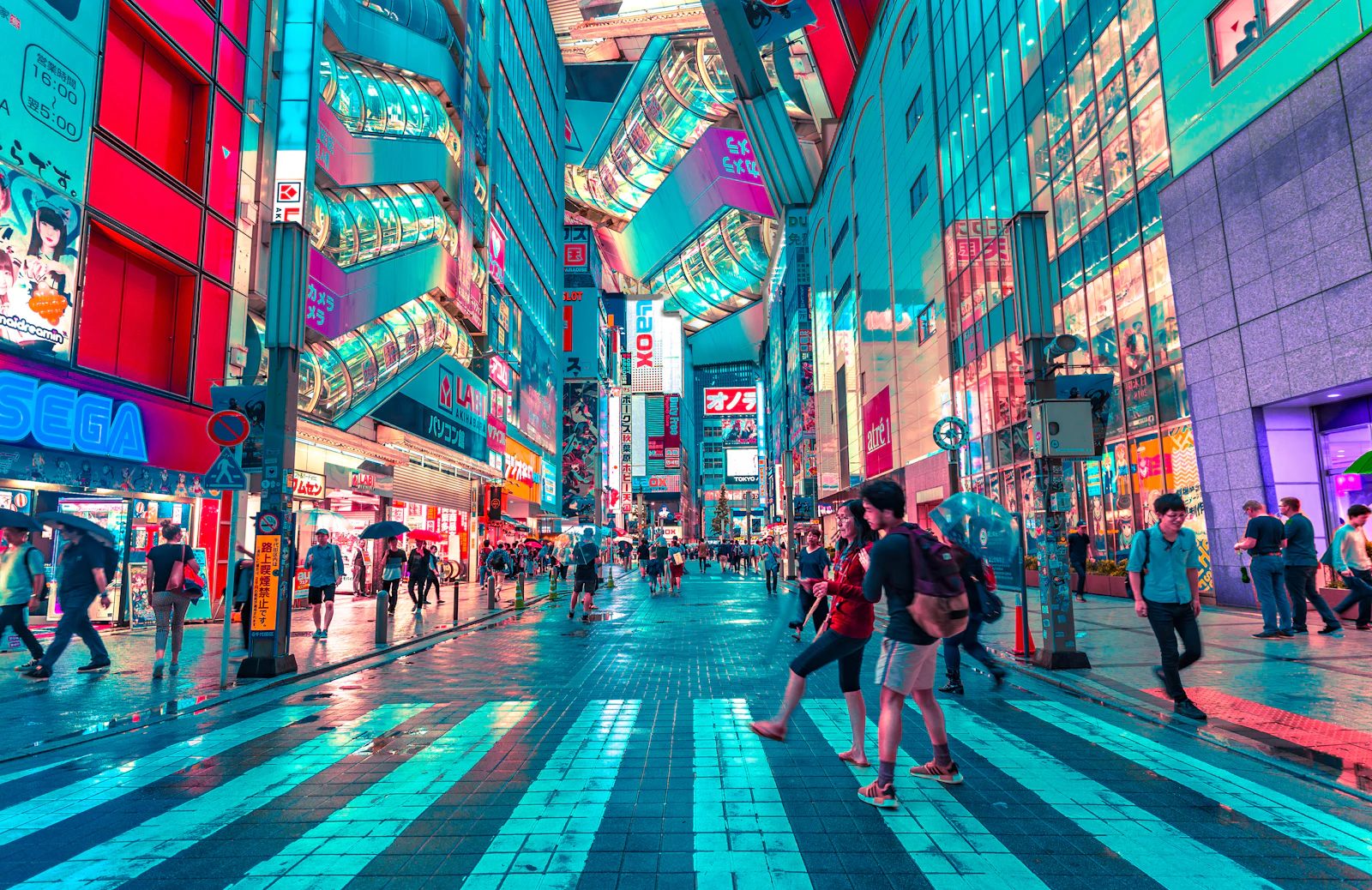
Tokyo in 5 Days: A First-Timer's Itinerary
A realistic five-day plan for a first trip to Tokyo — the big sights, the neighbourhoods that make the city, real food stops and Maps links, plus where to stay and what to budget.
Tokyo is enormous, and the classic first-timer mistake is trying to cross it three times a day. Five days lets you group the city by area — one neighbourhood cluster at a time — so you spend your hours in places, not on trains. It's enough to balance the must-sees with the side streets where Tokyo actually happens.
This itinerary moves district by district, with real stops linked to Google Maps and a sit-down meal or street-food stop built into each day. Pair it with a transit IC card and you'll rarely wait more than a few minutes for a train.
At a glance
Your day-by-day Tokyo route
A 5-day first-timer route
One area cluster per day so you travel less and see more — with the food, views and side streets that make each district worth the time.
Adds a Kamakura day trip (coast + Great Buddha) after the core city days. The day trip is placed mid-trip, not on arrival or departure.
Day 1Modern west — Harajuku, Shibuya, Shinjuku
- Meiji ShrineHarajuku
- Takeshita StreetHarajuku
- Tonkatsu (Maisen, Aoyama)Harajuku
- OmotesandoHarajuku
- Shibuya CrossingShibuya
- Shibuya SkyShibuya
- Omoide Yokocho yakitori barsShinjuku
- Golden GaiShinjuku
If it rains Omotesando shopping + Shibuya Sky indoor decks.
Add if you have time Free TMG observation deck at dusk.
Day 2Old east — Asakusa, Ueno, Akihabara
- Senso-ji TempleAsakusa
- Nakamise-doriAsakusa
- Tokyo SkytreeAsakusa
- Asakusa tempura housesAsakusa
- Ueno ParkUeno
- Tokyo National MuseumUeno
- Ameyoko MarketUeno
- Gyoza & Chinese-JapaneseCitywide
- Akihabara Electric TownAkihabara
If it rains Skytree, museum and malls are indoor.
Add if you have time Yanaka Ginza old-town walk.
Day 3Central & bay — market, Ginza, digital art
- Tsukiji Outer MarketTsukiji
- Ginza Shopping DistrictGinza
- Itoya Ginza (stationery)Ginza
- teamLab Planets ToyosuToyosu
- Monjayaki / okonomiyakiTsukishima
- Odaiba Seaside ParkOdaiba
If it rains teamLab + Ginza depachika indoor.
Add if you have time Toyosu Market at dawn (closed Sun/some Wed).
Day 4Day trip — Kamakura coast & Great Buddha
- Kamakura Great Buddha (day trip)Day trip
- Standing soba countersCitywide
- Kamakura Great Buddha (day trip)Day trip
- Shibuya izakayaShibuya
- Shibuya CrossingShibuya
If it rains If weather is poor, swap the coast walk for the Tokyo National Museum / Mori Art Museum in town.
Add if you have time Add Hase-dera temple and Enoshima island if time allows.
Day 5Palace, art & a classic skyline
- Imperial Palace East GardensMarunouchi
- Japanese curry riceCitywide
- Mori Art MuseumRoppongi
- Yakiniku (grilled meat)Citywide
- Tokyo TowerRoppongi
If it rains Mori Art Museum (indoor, includes a city view).
Add if you have time Add a Ginza Muji/Itoya stop.
Route last checked 2026-06-14 — verify hours and bookings before you go.
Want this as an interactive guide you can reshape by length, budget and pace — with the maps, food and a one-tap PDF?
Get the Tokyo Destination Pass · S$16.90 Or build a free planWhere to stay in Tokyo
Stay near a JR Yamanote or major metro station for the easiest access. Tokyo hotels are compact; 'comfortable' usually means more space and location rather than luxury alone. Prices are estimates and rise sharply in cherry-blossom and autumn-foliage seasons and around major holidays.
Shinjuku
First-timers, nightlife, transport
Tokyo Station / Marunouchi
Central base, shinkansen day trips
Shibuya
Younger travellers, shopping
Asakusa
Budget, old-Tokyo charm
Ueno
Budget, museums, Narita access
By budget
- Budget — S$40–80 · Capsule hotels, Hostels, Budget business hotels
- Mid-range — S$140–220 · 3-star business and boutique hotels
- Comfortable — S$280–720 · 4–5 star hotels, Well-located design hotels
- Book early for late March–early April (sakura) and November (foliage).
- Check the nearest station and line before booking — a 10-minute walk with luggage adds up.
- Many hotels allow early luggage drop even before check-in.
Prices and availability change constantly. Confirm current rates on the hotel or a booking site before paying.
What to budget for Tokyo
Per person, per day, excluding flights. A rough guide only — your costs depend on season, area and pace.
Budget
- Accommodation: Capsule/hostel/budget business hotel (JPY 4,000–9,000).
- Meals: Convenience stores, ramen, standing soba, conveyor sushi (JPY 500–1,200/meal).
- Transport: IC card pay-as-you-go; walk between close stops.
- Attractions: Prioritise free sights; one paid highlight per few days.
- Evening: Omoide Yokocho skewers, konbini drinks by the river, free night views.
Mid-range
- Accommodation: 3-star business or boutique hotel (JPY 12,000–22,000).
- Meals: Mix of casual restaurants and one nicer meal (JPY 1,000–3,000/meal).
- Transport: IC card; occasional taxi for convenience.
- Attractions: Book a couple of paid highlights (e.g. teamLab, Shibuya Sky).
- Evening: Izakaya dinners, a rooftop drink, one paid night view.
Comfortable
- Accommodation: 4–5 star or well-located design hotel (JPY 30,000–80,000).
- Meals: Good restaurants plus one omakase or kaiseki (JPY 2,500–15,000/meal).
- Transport: Taxis/ride-hailing where convenient; IC card for quick hops.
- Attractions: Add premium experiences and museums freely.
- Evening: Reserved fine dining, hotel/skyline bars.
When to visit Tokyo
Weather, daylight and seasonal events vary year to year. Treat this as general guidance and check a forecast and official event calendars close to your dates.
Winter Dec, Jan, Feb
Cold and dry, roughly 2–12°C. Snow is occasional, rarely heavy in central Tokyo.
Plan more indoor time (museums, depachika, teamLab); shorter daylight means earlier viewpoints for sunset.
Look out for: Winter illuminations citywide, New Year shrine visits (very busy 1–3 Jan)
Spring Mar, Apr, May
Mild, roughly 10–22°C; pleasant for walking.
Book accommodation early; expect crowds at Shinjuku Gyoen, Ueno, Nakameguro and Sumida Park during sakura.
Look out for: Cherry blossom (sakura), Golden Week holidays
Summer Jun, Jul, Aug
Hot and humid, often 28–35°C.
Shift sightseeing to morning and evening; use air-conditioned museums and malls at midday; stay hydrated.
Look out for: Summer festivals (matsuri), Fireworks (hanabi)
Autumn Sep, Oct, Nov
Cooling and comfortable, roughly 12–25°C.
For foliage day trips, go early to beat crowds; central gardens (Shinjuku Gyoen) are quieter alternatives.
Look out for: Autumn foliage (koyo)
Common Tokyo mistakes to avoid
- Over-packing each day and zig-zagging across the city — group by area.
- Skipping advance bookings for popular venues (e.g. teamLab).
- Underestimating walking — Tokyo days add up fast.
- Assuming card-only — carry some cash for small stalls and shrines.
- Ignoring public-holiday closures and seasonal crowds.
Good to know in Tokyo
Getting around
- Tokyo Metro + Toei subway cover the centre; JR Yamanote loop links the big districts.
- Google Maps gives accurate platforms, exits and times — exits matter in large stations.
- Avoid 08:00–09:30 and 17:30–19:00 rush with luggage.
- Taxis are reliable and safe but expensive; trains are faster within the city.
Buy and top up at any station machine. Tap on entry and exit on metro, JR and buses. Also works at convenience stores and many vending machines.
Money & connectivity
- Increasingly card- and IC-friendly, but carry some cash for small stalls, shrines and older shops. IC cards work for many vending machines and convenience stores.
- Pocket Wi-Fi and travel eSIMs are widely available; airport counters rent Wi-Fi. Free Wi-Fi exists but is patchy — a SIM/eSIM is more reliable.
- No tipping. It is not expected and can cause confusion. Service is included.
Local etiquette
- Be quiet on trains; phone calls are frowned upon.
- Carry your rubbish until you find a bin — public bins are scarce.
- Remove shoes where indicated (some restaurants, temples, ryokan).
- Queue neatly and stand on the correct side of escalators (left in Tokyo).
Police: 110 · Ambulance / Fire: 119 · Japan Visitor Hotline (24h, multilingual): 050-3816-2787 · Keep your accommodation address in Japanese for taxis.
Tokyo — frequently asked questions
Is 5 days enough for Tokyo?
5–7 days is the usual recommendation for Tokyo. The plan here runs to 5 days, and the full guide builds routes from 1–7 days — so you can shorten or extend it to fit your trip.
What should I eat in Tokyo?
Tokyo's highlights include Tsukiji Outer Market sushi & sashimi stalls, Ramen in Shinjuku, Omoide Yokocho yakitori bars, Tonkatsu (Maisen, Aoyama), Ginza department-store food halls (depachika) and more. Each is linked to Google Maps in the route above; famous spots queue at peak times, so go off-peak or pick a neighbouring stall.
Where should I stay in Tokyo for the first time?
Good bases include Shinjuku (First-timers, nightlife, transport); Tokyo Station / Marunouchi (Central base, shinkansen day trips); Shibuya (Younger travellers, shopping). See "Where to stay" above for the full breakdown by budget.
How much does Tokyo cost per day?
Roughly around S$90–135 a day on a budget, S$145–215 mid-range, S$225–390 comfortable per person, excluding flights and accommodation swings. See "Budget" above for what each tier covers.
When is the best time to visit Tokyo?
Weather, daylight and seasonal events vary year to year. Treat this as general guidance and check a forecast and official event calendars close to your dates. See "When to go" above for the month-by-month detail.
Do I need a visa for Japan?
Entry requirements vary by passport and change often. Many nationalities enter Japan visa-free for short stays, but you must confirm your own requirements on the official immigration website before booking.
Plan Tokyo your way
Start free, or get the complete interactive guide — maps, food, day-by-day routes you can reshape, and a one-tap PDF.