
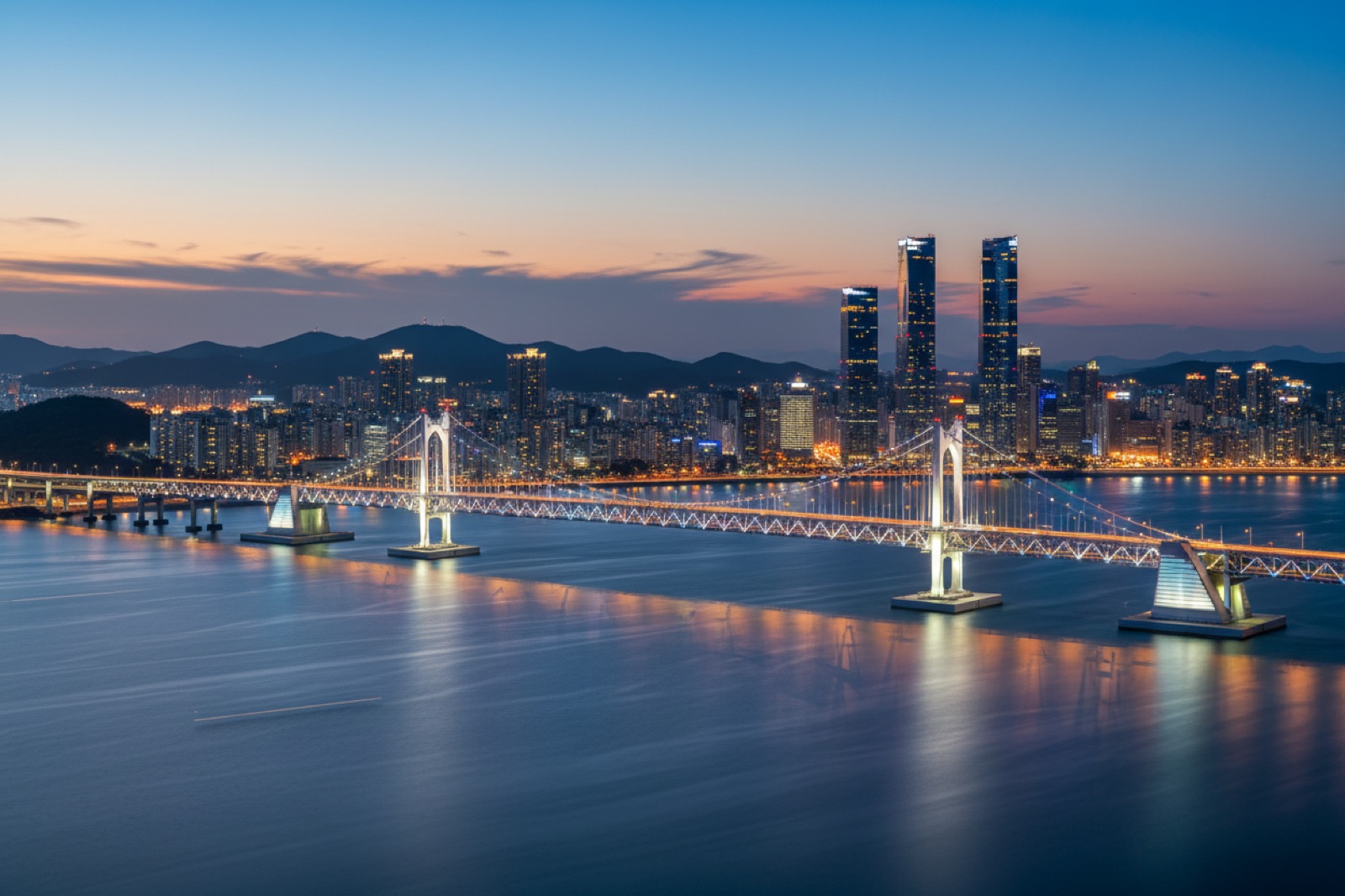
Busan in 3 Days: Beaches, Seafood & Hillside Villages
Gamcheon's painted hillside, Jagalchi fish market and Busan Tower, a seaside temple and the beaches, then the southern cliff-coast and Yeongdo's café villages — a practical 3-day Busan plan with Maps links, budgets and the local food to seek out.
Busan is Korea's second city and its coast — beaches and seafood markets, hillside art villages, mountain temples and the lit Gwangan Bridge, strung along the sea and into the hills. It's smaller and hillier than Seoul, so the trick is to plan around the metro lines and a few longer hops rather than crisscrossing the city.
This three-day route groups Busan by area so you're never doubling back: the old town and Gamcheon, then the eastern beaches and Haedong Yonggungsa, then the dramatic southern cliff-coast and Yeongdo's café villages. Busan's signature meals — dwaeji-gukbap, milmyeon, fresh hoe at Jagalchi — are cheap and, unusually for Korea, several carry genuine Bib Gourmand recognition (with the year, and always verify the current listing). Every stop links to Google Maps.
At a glance
Your day-by-day Busan route
A 3-day Busan route
Old town and Gamcheon, then the eastern beaches and a seaside temple, then the southern cliff-coast and Yeongdo's art villages — Busan's three faces, grouped to avoid backtracking.
Old town and Gamcheon, then the eastern beaches and a seaside temple, then the dramatic southern cliff-coast and Yeongdo's art villages — Busan's three faces.
Day 1Old town, Gamcheon & Busan Tower
- Gamcheon Culture VillageSaha-gu
- Dwaeji-gukbap (pork & rice soup) Bib GourmandSeomyeon
If it rains The markets, BIFF/Gukje arcades and Busan Tower keep you sheltered; swap Gamcheon for Shinsegae Centum City.
Add if you have time Bibim-dangmyeon and ssiat-hotteok along BIFF Square.
Day 2Haeundae, Yonggungsa & the night bay
- Milmyeon (Busan cold wheat noodles) Bib GourmandCitywide
- Haeundae BeachHaeundae
- Dongbaekseom Island & NurimaruHaeundae
- Chimaek (fried chicken & beer)Haeundae
If it rains Yonggungsa is exposed — swap for Shinsegae Centum City and an indoor lunch; The Bay 101 reflections still work from under cover.
Add if you have time The Blueline Park beach-train and sky-capsule at Songjeong.
Day 3Southern cliff-coast & Yeongdo's art villages
- Igidae Coastal WalkNam-gu
- Oryukdo SkywalkNam-gu
- Dongnae-pajeon (seafood scallion pancake) MICHELINDongnae
- Taejongdae Cliff ParkYeongdo
- Huinnyeoul Culture VillageYeongdo
- Jokbal & bossam (braised pork)Seomyeon
- Gwangalli Beach & Gwangan BridgeGwangalli
If it rains The cliff walks and skywalk close in storms — swap for the markets, Busan Museum of Art or Spa Land, and keep the Gwangalli bridge view from a café.
Add if you have time The Songdo Marine Cable Car and beach on the way back west.
Route last checked 2026-06-21 — verify hours and bookings before you go.
Want this as an interactive guide you can reshape by length, budget and pace — with the maps, food and a one-tap PDF?
Get the Busan Destination Pass · S$16.90 Or build a free planWhere to stay in Busan
Busan is spread along the coast, so your base shapes your trip. Haeundae is the beach-resort base with the big hotels and night views; Seomyeon is the central, best-value crossroads for food and nightlife; Nampo/Jagalchi puts you in the old-town markets and near Busan Station; Gwangalli is a relaxed beach with the bridge view. Stay within a few minutes of a metro station — the city's long.
Haeundae
First-timers, beach and big hotels; Centum City and The Bay 101
Seomyeon
Central value, food and nightlife at the metro crossroads
Nampo / Jagalchi
Old-town markets, Busan Tower and KTX access
Gwangalli
A calmer beach with the lit Gwangan Bridge and a younger bar scene
Yeongdo
Coastal cafés and views, quieter and scenic (fewer transit links)
By budget
- Budget — S$30–80 · Guesthouses & hostels, Budget business hotels
- Mid-range — S$90–220 · 3–4 star hotels, Beach-view business hotels
- Comfortable — S$250–700+ · 5-star beach resorts, Marine City high-rise hotels
- Haeundae sea-view rooms cost a premium and book out for the July–August beach season — reserve early.
- Seomyeon gives the best food-and-transit value and is central to both the beaches and the old town.
- If you want the postcard night view, a Marine City or Gwangalli room overlooks the lit bridge.
Rates and availability change constantly, and peak beach season is much dearer — confirm with the hotel or a booking site before paying.
What to budget for Busan
Per person, per day, excluding flights. A rough guide only — your costs depend on season, area and pace.
Budget
- Accommodation: Guesthouse, hostel or budget business hotel near a metro (₩30,000–80,000).
- Meals: Markets and gukbap alleys — dwaeji-gukbap, milmyeon, eomuk skewers, BIFF street snacks (₩3,000–11,000/meal).
- Transport: Metro + buses on a T-money card; walk the markets and beaches.
- Attractions: Free icons — Gamcheon, Haeundae & Gwangalli beaches, Yongdusan Park, Taejongdae walk, Igidae/Oryukdo, the temples.
- Evening: Gwangalli bridge lights, The Bay 101 skyline, a market dinner and a convenience-store beer by the sea.
Mid-range
- Accommodation: 3–4 star or beach-view business hotel (₩90,000–220,000).
- Meals: Market hoe and grilled fish, Korean BBQ, a sit-down dongnae-pajeon, plus the café coast (₩12,000–35,000/meal).
- Transport: Metro plus Kakao T taxis for the hilly and far spots (Yonggungsa, Gamcheon, Taejongdae).
- Attractions: Add the Songdo cable car, Busan Tower, the Blueline sky-capsule or a Gyeongju KTX day trip.
- Evening: Chimaek on The Bay 101 terraces, a Gwangalli craft-beer bar, or a Spa Land soak.
Comfortable
- Accommodation: 5-star Haeundae beach resort or a Marine City high-rise with the bridge view (₩250,000–700,000+).
- Meals: A Gijang snow-crab feast or a premium hanwoo-beef dinner, plus great specialty cafés (₩60,000–200,000+/head).
- Transport: Kakao T everywhere; a private car for the coast and Gyeongju.
- Attractions: Add a Gyeongju guided day, a luxury spa, a yacht or a fine-dining night.
- Evening: A skyline fine-dining dinner, then a rooftop or marina bar over the lit Gwangan Bridge.
When to visit Busan
Busan has four distinct seasons and a milder, breezier coastal climate than Seoul. Beach season is short (roughly July–August); spring and autumn are the prettiest. Check a forecast close to your dates — sea fog and typhoons can affect coastal sights.
Spring (cherry blossom & mild) Mar, Apr, May
Mild and pleasant, ~10–20°C, with cherry blossom in late March–early April and clear coastal days.
If blossoms are over, the coastal trails and temples are at their greenest; keep indoor backups for a wet spring day.
Look out for: Cherry blossom (late Mar–early Apr), Jinhae Gunhangje cherry festival (nearby)
Summer (beach season, hot & wet) Jun, Jul, Aug
Hot and humid, ~24–30°C, with the East-Asian monsoon (jangma) bringing heavy rain spells in late June–July and typhoon risk into August–September.
Plan beaches for the morning, retreat to Shinsegae/Spa Land or the markets in the wettest hours, and watch typhoon advisories.
Look out for: Haeundae & Gwangalli beach season, Busan Sea Festival (Aug), Gwangalli drone/fireworks shows
Autumn (clear & golden — the best) Sep, Oct, Nov
Crisp and clear, ~12–24°C, with low humidity and autumn colour from late October — arguably the best time to visit.
Ideal for the cliff walks, Taejongdae and Gyeongju; little need for wet-weather backups.
Look out for: Busan International Film Festival (early Oct), Autumn foliage (late Oct–Nov), Busan Fireworks Festival (autumn)
Winter (cold, dry & quiet) Dec, Jan, Feb
Cold but milder than Seoul, ~0–10°C, dry and often sunny; sea winds make it feel colder on the coast.
Favour the indoor markets, Spa Land, Busan Tower and temples; bundle up for the cliff viewpoints.
Look out for: Haeundae Polar Bear Swim (Jan), Quiet temples and clear winter views
Common Busan mistakes to avoid
- Treating Busan like Seoul — it's smaller, hillier and more spread out along the coast; plan around the metro lines and a few longer hops.
- Underestimating travel time between the beaches (Haeundae, Gwangalli) and the old town (Nampo, Jagalchi) — they're at opposite ends.
- Skipping the markets for malls — Jagalchi, Gukje and the BIFF street stalls are the real Busan food experience.
- Going to Gamcheon Culture Village in the midday heat — it's a steep, sun-exposed hillside; go earlier or later.
- Not checking ferry/cable-car and temple hours, which change seasonally — confirm before you go.
Good to know in Busan
Getting around
- The Metro (lines 1–4) is the backbone — clean, cheap, English-signed and reaching the markets, Seomyeon and the beaches.
- Buses fill the gaps to the temples, Gamcheon and the coast; tap the same T-money card.
- Taxis via Kakao T are reasonable and handy for the hilly or far-flung spots (Yonggungsa, Gamcheon, Taejongdae).
- The KTX from Busan Station reaches Seoul in ~2h40m and Gyeongju in ~30–50 min — book popular trains ahead.
- Walking is great in the markets and along the beaches, but expect stairs and slopes in the hill villages.
Buy a T-money or Cashbee card at any metro station or convenience store, top it up with cash, and tap on the metro and buses. The same card pays at convenience stores. For door-to-door, hail a metere…
Money & connectivity
- Cards and mobile pay are accepted almost everywhere, including most market stalls; carry a little cash for the oldest market vendors and street-food carts. A T-money/Cashbee card covers transit and many convenience stores.
- Excellent, ubiquitous 4G/5G; cheap tourist SIMs/eSIMs at Gimhae airport. Free Wi-Fi across the metro, cafés and many public areas.
- Not expected anywhere — no tipping in restaurants, taxis or hotels. Prices are as marked.
Local etiquette
- Use both hands when giving or receiving money, cards or gifts, and when pouring or receiving a drink with elders.
- Remove shoes where indicated (temples, some traditional restaurants and guesthouses).
- It's polite to be quiet on the metro; priority seats are left free even when the train is full.
- At a seafood market like Jagalchi, you pick the fish downstairs and pay a small fee to have it prepared upstairs — agree the price first.
Police: 112 · Fire & ambulance: 119 · Tourist hotline (24h, multilingual): 1330 · Korea is very safe; tap water is officially drinkable but most locals drink bottled or filtered.
Busan — frequently asked questions
How many days do you need in Busan?
3–4 days is the usual recommendation for Busan. The plan here runs to 3 days, and the full guide builds routes from 1–5 days — so you can shorten or extend it to fit your trip.
What food is Busan known for?
Busan's highlights include Dwaeji-gukbap (pork & rice soup), Milmyeon (Busan cold wheat noodles), Dongnae-pajeon (seafood scallion pancake), Jagalchi hoe & grilled fish, Ssiat-hotteok (seeded sweet pancake) and more. Each is linked to Google Maps in the route above; famous spots queue at peak times, so go off-peak or pick a neighbouring stall.
Where should I stay in Busan?
Good bases include Haeundae (First-timers, beach and big hotels; Centum City and The Bay…); Seomyeon (Central value, food and nightlife at the metro crossroads); Nampo / Jagalchi (Old-town markets, Busan Tower and KTX access). See "Where to stay" above for the full breakdown by budget.
How much does Busan cost per day?
Roughly around S$55–95 a day on a budget, S$100–180 mid-range, S$190–360+ comfortable per person, excluding flights and accommodation swings. See "Budget" above for what each tier covers.
When is the best time to visit Busan?
Busan has four distinct seasons and a milder, breezier coastal climate than Seoul. Beach season is short (roughly July–August); spring and autumn are the prettiest. Check a forecast close to your dates — sea fog and typhoons can affect coastal sights. See "When to go" above for the month-by-month detail.
Do I need a visa or K-ETA for South Korea?
Many nationalities enter South Korea visa-free for short tourism, but most visa-free visitors must hold a valid K-ETA (electronic travel authorisation) — though K-ETA has been temporarily waived for some nationalities in stated periods. Rules and the exemption list change; confirm your own K-ETA/visa requirement on the official K-ETA and Korea Immigration websites before booking.
Plan Busan your way
Start free, or get the complete interactive guide — maps, food, day-by-day routes you can reshape, and a one-tap PDF.