
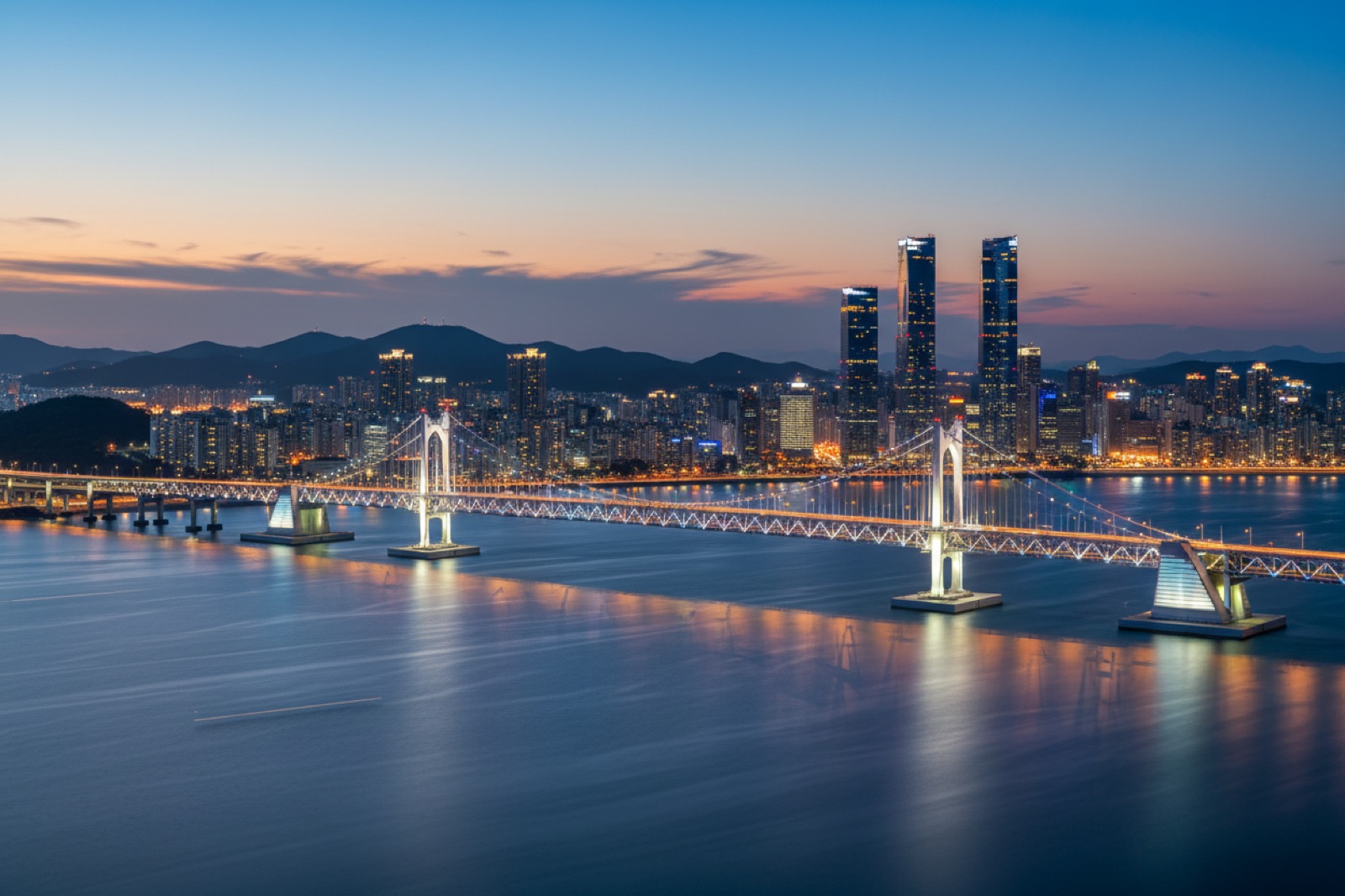
Busan
Korea's coastal city — beaches and seafood markets, hillside art villages, mountain temples and neon nightlife between the sea and the hills.
A sample 3-day Busan route
Old town and Gamcheon, then the eastern beaches and a seaside temple, then the dramatic southern cliff-coast and Yeongdo's art villages — Busan's three faces.
- Day 1Old town, Gamcheon & Busan TowerSaha-gu · Nampo
- Day 2Haeundae, Yonggungsa & the night bayHaeundae · Gijang · Gwangalli
- Day 3Southern cliff-coast & Yeongdo's art villagesNam-gu · Yeongdo · Gwangalli
This is one of several routes in the guide — change the length, budget and dates yourself in the workspace.
Where to eat in Busan
MICHELIN & Bib picks show the year awarded — selections are revised yearly, so confirm current status before you go. Every name links to a Google Maps search.
- Dwaeji-gukbap (pork & rice soup) Bib Gourmand
Milky pork-bone broth with rice and sliced pork, fixed with chives, salted shrimp and ssamjang — Busan's defining bowl
- Milmyeon (Busan cold wheat noodles) Bib Gourmand
Chewy wheat noodles in icy beef-and-herb broth (mul) or spicy-sauced (bibim) — Busan's post-war answer to naengmyeon
A thick griddled pancake of whole spring onions and seafood bound in egg batter — Busan's celebrated version, traditionally with makgeolli rice wine
Pick a fish from the market floor; eat it sliced as hoe (sashimi) or grilled upstairs, with sides and soju
A fried brown-sugar pancake split and stuffed with toasted seeds and nuts — the famous BIFF Square street snack
Busan is the home of Korean fish cake — skewers in hot broth from street carts, or upscale bakery-style eomuk at Samjin and the like
When to go to Busan
Busan has four distinct seasons and a milder, breezier coastal climate than Seoul. Beach season is short (roughly July–August); spring and autumn are the prettiest. Check a forecast close to your dates — sea fog and typhoons can affect coastal sights.
Spring (cherry blossom & mild) Mar, Apr, May
Mild and pleasant, ~10–20°C, with cherry blossom in late March–early April and clear coastal days.
If blossoms are over, the coastal trails and temples are at their greenest; keep indoor backups for a wet spring day.
Look out for: Cherry blossom (late Mar–early Apr), Jinhae Gunhangje cherry festival (nearby)
Summer (beach season, hot & wet) Jun, Jul, Aug
Hot and humid, ~24–30°C, with the East-Asian monsoon (jangma) bringing heavy rain spells in late June–July and typhoon risk into August–September.
Plan beaches for the morning, retreat to Shinsegae/Spa Land or the markets in the wettest hours, and watch typhoon advisories.
Look out for: Haeundae & Gwangalli beach season, Busan Sea Festival (Aug), Gwangalli drone/fireworks shows
Autumn (clear & golden — the best) Sep, Oct, Nov
Crisp and clear, ~12–24°C, with low humidity and autumn colour from late October — arguably the best time to visit.
Ideal for the cliff walks, Taejongdae and Gyeongju; little need for wet-weather backups.
Look out for: Busan International Film Festival (early Oct), Autumn foliage (late Oct–Nov), Busan Fireworks Festival (autumn)
Winter (cold, dry & quiet) Dec, Jan, Feb
Cold but milder than Seoul, ~0–10°C, dry and often sunny; sea winds make it feel colder on the coast.
Favour the indoor markets, Spa Land, Busan Tower and temples; bundle up for the cliff viewpoints.
Look out for: Haeundae Polar Bear Swim (Jan), Quiet temples and clear winter views
What Busan costs
Per person, per day, excluding flights. A rough guide only — your costs depend on season, area and pace.
Budget
- Accommodation: Guesthouse, hostel or budget business hotel near a metro (₩30,000–80,000).
- Meals: Markets and gukbap alleys — dwaeji-gukbap, milmyeon, eomuk skewers, BIFF street snacks (₩3,000–11,000/meal).
- Transport: Metro + buses on a T-money card; walk the markets and beaches.
- Attractions: Free icons — Gamcheon, Haeundae & Gwangalli beaches, Yongdusan Park, Taejongdae walk, Igidae/Oryukdo, the temples.
- Evening: Gwangalli bridge lights, The Bay 101 skyline, a market dinner and a convenience-store beer by the sea.
Mid-range
- Accommodation: 3–4 star or beach-view business hotel (₩90,000–220,000).
- Meals: Market hoe and grilled fish, Korean BBQ, a sit-down dongnae-pajeon, plus the café coast (₩12,000–35,000/meal).
- Transport: Metro plus Kakao T taxis for the hilly and far spots (Yonggungsa, Gamcheon, Taejongdae).
- Attractions: Add the Songdo cable car, Busan Tower, the Blueline sky-capsule or a Gyeongju KTX day trip.
- Evening: Chimaek on The Bay 101 terraces, a Gwangalli craft-beer bar, or a Spa Land soak.
Comfortable
- Accommodation: 5-star Haeundae beach resort or a Marine City high-rise with the bridge view (₩250,000–700,000+).
- Meals: A Gijang snow-crab feast or a premium hanwoo-beef dinner, plus great specialty cafés (₩60,000–200,000+/head).
- Transport: Kakao T everywhere; a private car for the coast and Gyeongju.
- Attractions: Add a Gyeongju guided day, a luxury spa, a yacht or a fine-dining night.
- Evening: A skyline fine-dining dinner, then a rooftop or marina bar over the lit Gwangan Bridge.
Where to stay in Busan
Busan is spread along the coast, so your base shapes your trip. Haeundae is the beach-resort base with the big hotels and night views; Seomyeon is the central, best-value crossroads for food and nightlife; Nampo/Jagalchi puts you in the old-town markets and near Busan Station; Gwangalli is a relaxed beach with the bridge view. Stay within a few minutes of a metro station — the city's long.
Haeundae
First-timers, beach and big hotels; Centum City and The Bay 101
Seomyeon
Central value, food and nightlife at the metro crossroads
Nampo / Jagalchi
Old-town markets, Busan Tower and KTX access
Gwangalli
A calmer beach with the lit Gwangan Bridge and a younger bar scene
Yeongdo
Coastal cafés and views, quieter and scenic (fewer transit links)
By budget
- Budget — S$30–80 · Guesthouses & hostels, Budget business hotels
- Mid-range — S$90–220 · 3–4 star hotels, Beach-view business hotels
- Comfortable — S$250–700+ · 5-star beach resorts, Marine City high-rise hotels
- Haeundae sea-view rooms cost a premium and book out for the July–August beach season — reserve early.
- Seomyeon gives the best food-and-transit value and is central to both the beaches and the old town.
- If you want the postcard night view, a Marine City or Gwangalli room overlooks the lit bridge.
Rates and availability change constantly, and peak beach season is much dearer — confirm with the hotel or a booking site before paying.
Common Busan mistakes to avoid
- Treating Busan like Seoul — it's smaller, hillier and more spread out along the coast; plan around the metro lines and a few longer hops.
- Underestimating travel time between the beaches (Haeundae, Gwangalli) and the old town (Nampo, Jagalchi) — they're at opposite ends.
- Skipping the markets for malls — Jagalchi, Gukje and the BIFF street stalls are the real Busan food experience.
- Going to Gamcheon Culture Village in the midday heat — it's a steep, sun-exposed hillside; go earlier or later.
- Not checking ferry/cable-car and temple hours, which change seasonally — confirm before you go.
Good to know
Where to stay
Haeundae, Seomyeon, Nampo-dong / Jagalchi, Gwangalli.
How long to go
3–4 days suits most visitors. Shorter and longer routes are built in, so you are never padding a trip to fill days.
Busan travel guides
In-depth, free reads with real routes, Maps links, budgets and the mistakes to skip:
- Busan in 3 Days: Beaches, Seafood & Hillside Villages
Gamcheon's painted hillside, Jagalchi fish market and Busan Tower, a seaside temple and the beaches, then the southern cliff-coast and Yeongdo's café villages — a practical 3-day Busan plan with Maps links, budgets and the local food to seek out.
Plan a nearby trip
Easy to pair with Busan on the same trip — tap through to a full guide.
Plan Busan your way
Start free, or unlock the full interactive guide with maps, food, day-by-day routes and a 1-click PDF.