
Xi'an in 3 Days: A Practical Itinerary
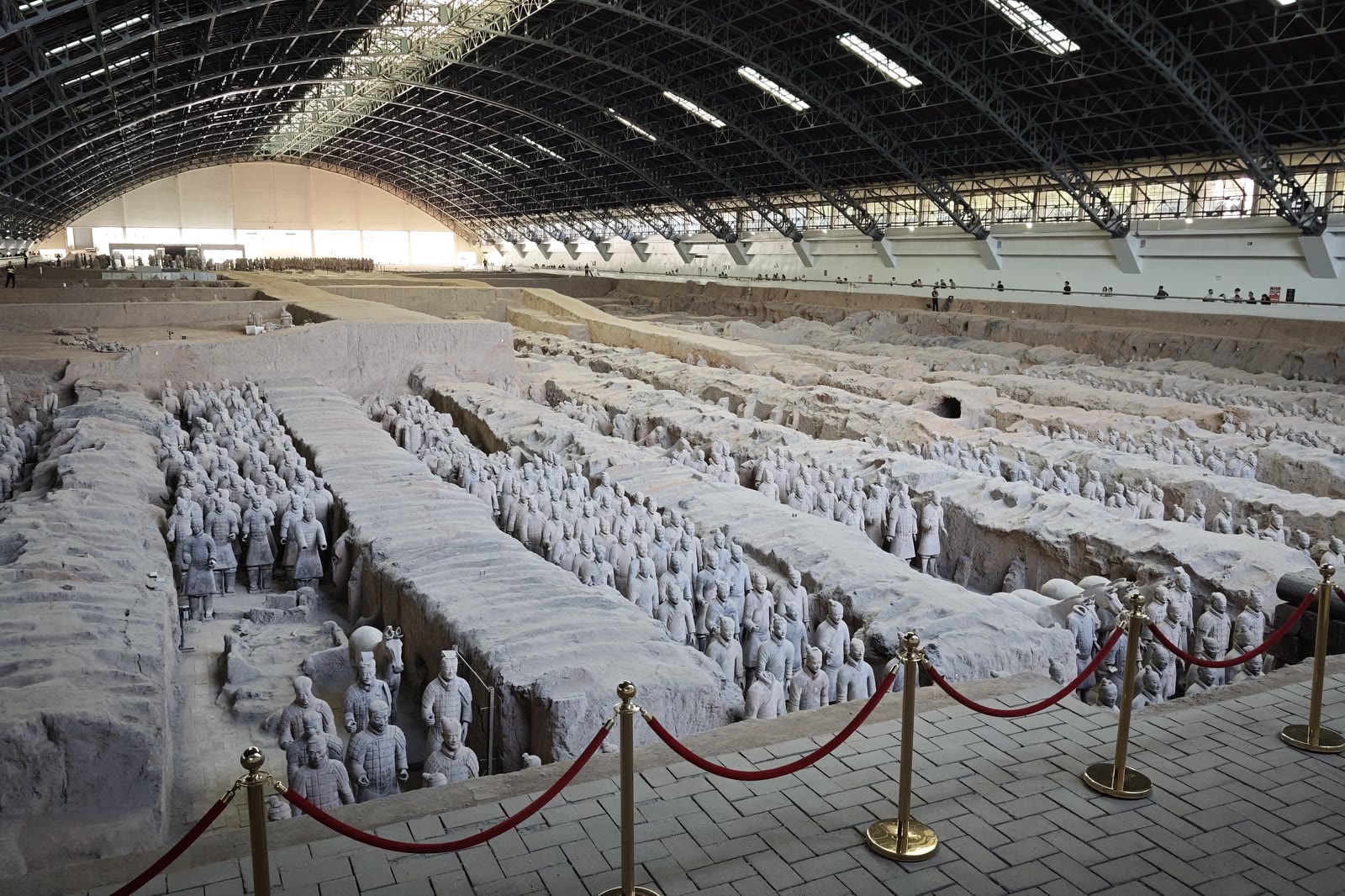
The Terracotta Army at 08:30, cycling the Ming city wall, the Muslim Quarter's paomo and noodles, the Shaanxi History Museum and the Big Wild Goose Pagoda by night — a realistic three-day Xi'an plan with Chinese names for every stop, the booking rules that matter and budgets for Singapore travellers.
Xi'an was China's capital for more than a thousand years, and it shows: a complete Ming city wall wraps the old centre, Tang pagodas rise over the southern suburbs, and an hour east the First Emperor's clay army stands in its pits. Three days covers the essentials without rushing — and Singaporeans can go visa-free for up to 30 days.
This plan keeps arrival day inside the walls — the Bell and Drum Towers, the Great Mosque, a bike ride round the wall and a paomo dinner in the Muslim Quarter — puts the Terracotta Army at opening on day two with Huaqing Palace and the pagoda's night boulevard, and ends with the Shaanxi History Museum and the Big Wild Goose Pagoda on the metro line to the airport. The Terracotta Army and the museum need real-name bookings with your passport, so set up Alipay or WeChat Pay before you fly, book as soon as your dates are fixed, and carry your passport every day.
At a glance
Your day-by-day Xi'an route
A 3-day Xi'an route
A walled-city arrival day with no timed bookings, the Terracotta Army at 08:30 with Huaqing Palace and the pagoda by night, then the Shaanxi History Museum and the Big Wild Goose Pagoda on Line 2/4 for the airport.
The recommended trip. A walled-city arrival day with no timed bookings; the Terracotta Army at 08:30 with Huaqing Palace and the Big Wild Goose Pagoda's night boulevard; then the Shaanxi History Museum (booked 5 days ahead), the pagoda by day and the calligraphy street by the South Gate on Line 2 for the airport. On a Mon–Wed start the Monday falls on the open-air walled-city day, so the museum's low-season Monday closure is avoided.
Day 1Arrival day — the Bell and Drum Towers, the Great Mosque, cycling the City Wall and the Muslim Quarter at night
- Bell TowerBell Tower & Muslim Quarter
- Drum TowerBell Tower & Muslim Quarter
- Fan Ji La Zhi Rou Jia Mo (Zhubashi)Bell Tower & Muslim Quarter
- Great Mosque of Xi'an (Huajue Lane)Bell Tower & Muslim Quarter
- Xi'an City Wall — South Gate (Yongningmen) and cycling the wallSouth Gate & Beilin
- Lao Mi Jia Da Yu Paomo (Xiyangshi)Bell Tower & Muslim Quarter
- Muslim Quarter (Huimin Street)Bell Tower & Muslim Quarter
If it rains The tower halls and the mosque's covered verandas give some shelter; in steady rain swap the open-top wall ride for the Forest of Steles Museum by the South Gate (¥85, book online, mostly indoor halls), then walk Shuyuanmen's shopfronts. The Muslim Quarter's restaurants are indoors.
Add if you have time Add Shuyuanmen's calligraphy shops below the South Gate, a shadow-puppet show at the Gao Family Courtyard on Beiyuanmen (¥30, before about 18:00), or the floodlit Bell and Drum Tower Square after dinner (free; the towers close to visitors at 18:00 in the low season).
Day 2The Terracotta Army at opening and Huaqing Palace, then the Big Wild Goose Pagoda by night
- Xi'an Fanzhuang (Datang Everbright City)Big Wild Goose Pagoda & Qujiang
- Datang Everbright City (Grand Tang Mall night street)Big Wild Goose Pagoda & Qujiang
- Big Wild Goose Pagoda North Square fountain showBig Wild Goose Pagoda & Qujiang
If it rains The three pits are vast roofed halls, so the Terracotta Army works in any weather. Huaqing Palace is mostly open-air: in heavy rain ride back on Line 9 and Line 1 to the indoor Banpo Museum (¥55) instead. Swap the open-air boulevard for the indoor Chang'an Twelve Hours street (¥68–128); the fountain pauses in storms.
Add if you have time With energy left, stay on Datang Everbright City after the 21:00 fountain — street shows run to about 22:30. Late March to October you could instead stay in Lintong for The Song of Everlasting Sorrow on the Huaqing Palace lake (from about 19:00–19:30, ¥228–368, real-name booking; return coach to the Bell Tower or about an hour by DiDi).
Day 3Departure day — the Shaanxi History Museum, the Big Wild Goose Pagoda and Shuyuanmen
- Shaanxi History MuseumBig Wild Goose Pagoda & Qujiang
- Wei Jia Liangpi (Datang Everbright City)Big Wild Goose Pagoda & Qujiang
- Big Wild Goose Pagoda (Da Ci'en Temple)Big Wild Goose Pagoda & Qujiang
- Shuyuanmen Ancient Culture StreetSouth Gate & Beilin
- Chun Fa Sheng Hulutou Paomo (Nanyuanmen)South Gate & Beilin
If it rains The museum is fully indoor — add the Tang Treasures (¥30) or Tang Murals gallery (¥270) and stay longer; skip the pagoda climb and swap Shuyuanmen for the Forest of Steles Museum next to it (¥85, indoor halls, last entry 17:00).
Add if you have time With a late flight, add the Forest of Steles Museum (book online, last entry 17:00) beside Shuyuanmen, or Daxingshan Temple (free) near Xiaozhai.
Route last checked 2026-10-03 — verify hours and bookings before you go.
Want this as an interactive guide you can reshape by length, budget and pace — with the maps, food and a one-tap PDF?
Get the Xi'an Destination Pass · S$9.90 Or build a free planWhere to stay in Xi'an
Stay inside or right by the Ming city wall, near a Line 2 station — the Bell Tower or the South Gate — and the old city, the Muslim Quarter and the wall are walkable, the Big Wild Goose Pagoda is three stops south, and Line 2 runs straight to Xi'an North for the Line 14 airport train and Huashan trains. Hotels are good value by Singapore standards but jump during Golden Week (1–7 Oct), Chinese New Year and the July–August school holidays.
Bell Tower
First-timers, food and transport
South Gate (Yongningmen)
The wall and a quieter base
Big Wild Goose Pagoda / Qujiang
The museum and the night boulevard
Muslim Quarter edge / Sajinqiao
Food lovers
Xi'an North Station
Early trains only
By budget
- Budget — S$29–57 · Hostels with private rooms, Chinese budget chains such as Hanting or Ji Hotel — check that the branch accepts foreigners
- Mid-range — S$67–134 · 4-star and boutique hotels, Upper-mid chains (Atour, Holiday Inn Express, Mercure)
- Comfortable — S$172–477 · 5-star international hotels, Design hotels near the wall or Qujiang
- Check the hotel accepts foreign guests (涉外). Many small Chinese hotels and guesthouses aren't licensed to register foreigners and will turn you away at check-in; booking sites flag 'mainland Chinese guests only'.
- The hotel registers your passport with the police at check-in. In an Airbnb or private home, you or your host must register at the local police station within 24 hours.
- Pay large hotel bills by card at the desk — Alipay/WeChat Pay add 3% on foreign-card payments above ¥200.
Prices and availability change constantly, and a hotel's licence to host foreigners can change. Confirm current rates and foreign-guest acceptance with the hotel or booking site before paying.
What to budget for Xi'an
Per person, per day, excluding flights. A rough guide only — your costs depend on season, area and pace.
Budget
- Accommodation: Hostel private room or a foreigner-licensed budget chain near a Line 1/2 station (¥150–300/night, shared).
- Meals: Paomo, biangbiang noodles, liangpi and roujiamo in the Muslim Quarter side lanes and Sajinqiao (¥15–50 a meal).
- Transport: Metro by ride code (¥2–9 a ride) and the bus to the Terracotta Army; walk inside the wall.
- Attractions: Terracotta Army (¥120) and the City Wall (¥54); the free Shaanxi History Museum and Xi'an Museum (book ahead), the ¥10 Da Ci'en Temple and the free fountain and night boulevard.
- Evening: The Muslim Quarter night market, the lit Bell and Drum Towers, Datang Everbright City and the 21:00 fountain — all free.
Mid-range
- Accommodation: 4-star or boutique hotel by the Bell Tower or South Gate (¥350–700/night).
- Meals: Old-brand paomo and dumpling banquets (Tong Sheng Xiang, De Fa Chang) and a sit-down Shaanxi dinner at Xi'an Fanzhuang (¥40–120 a meal).
- Transport: Metro plus DiDi for evenings and one leg to Lintong (¥100–150).
- Attractions: Terracotta Army, Huaqing Palace, the City Wall with a bike, the Forest of Steles and the pagoda climb.
- Evening: Datang Everbright City and the fountain, Chang'an Twelve Hours, a drink on Defuxiang.
Comfortable
- Accommodation: 5-star or design hotel by the Bell Tower or in Qujiang (¥900–2,500/night).
- Meals: Banquet-style Shaanxi dinners, the De Fa Chang dumpling feast and hotel restaurants alongside the best paomo counters.
- Transport: A private car and driver for the Lintong day (agree the price in advance), DiDi elsewhere.
- Attractions: A licensed private guide at the Terracotta Army, the Tang Murals gallery, Tang Paradise and Han Yangling on the way to the airport.
- Evening: Front-row seats for the Song of Everlasting Sorrow at Huaqing Palace in season, or hotel bars over the wall.
When to visit Xi'an
Weather, daylight, air quality and holiday dates vary year to year. Treat this as general guidance and check a forecast, the AQI (aqicn.org or the Ministry of Ecology and Environment) and official holiday calendars close to your dates.
Winter Dec, Jan, Feb
Cold and dry, roughly -4 to 8°C; occasional light snow. Wind on top of the City Wall and on Huashan is bitter.
The heating season (from mid-November) brings Xi'an's worst smog — check the AQI and pack KN95 masks. Lean on the indoor pits and museums, remember the Shaanxi History Museum closes on Mondays in the low season, and skip Huashan when paths are icy.
Look out for: Chang'an lantern festival on the City Wall (New Year period; ¥78 wall ticket in 2026), Snow on the wall and pagodas, Paomo and hot noodle season
Spring Mar, Apr, May
Mild, roughly 8–27°C, warming fast by May.
Book holiday-week tickets on release day; a good season for cycling the wall and for Huashan.
Look out for: Cherry blossom at Qinglong Temple (late March–early April), Spring green on Huashan, Longer high-season hours from mid-March
Summer Jun, Jul, Aug
Hot, often 30–38°C, with heatwaves over 40°C.
Do the Terracotta Army at 08:30 and the wall after 17:00; spend midday in the museums or the Chang'an Twelve Hours indoor street, and go out again after dark.
Look out for: Extended evening hours at the Bell and Drum Towers (to 21:30), Night life at Datang Everbright City, Huashan night hikes for sunrise
Autumn Sep, Oct, Nov
Comfortable, roughly 8–25°C, cooling sharply through November.
Avoid 1–7 October if you can; late October to early November is the sweet spot. Pack a layer for cold evenings on the wall and at the night boulevard.
Look out for: Golden ginkgo leaves (late October–November), Lintong pomegranates (September–October), Autumn colour on Huashan
Common Xi'an mistakes to avoid
- Turning up at the Terracotta Army without an online booking. Every visitor needs a real-name ticket booked with a passport on bmy.com.cn or the museum's WeChat accounts (up to about 8 days ahead) — there is no ticket window.
- Expecting to walk into the Shaanxi History Museum. Free tickets release 5 days ahead at 17:00 on the 陕西历史博物馆 WeChat account and weekend slots go in minutes; if you miss out, buy the ¥30 Tang Treasures or ¥270 Tang Murals ticket, which includes entry, or use the walk-in Qin-Han Gallery on Metro Line 14.
- Scheduling the Shaanxi History Museum on a Monday between mid-November and mid-March (low-season Monday closure), or the Xi'an Museum (Small Wild Goose Pagoda) on a Tuesday.
- Buying a 'Terracotta Army bus' or tour from touts at Xi'an Railway Station — some stop at jade and souvenir factories. Take Metro Line 9 to Huaqingchi and bus 613/602/306, or a DiDi, and hire guides only at the museum's official desk.
- Reaching the Terracotta Army at noon. Be at the gate at 08:30; by 10:00 Pit 1's railings are three deep with tour groups.
- Tapping a Singapore card at Xi'an Metro gates — it doesn't reliably work here (unlike Beijing, Shanghai or Chengdu). Set up the Alipay or WeChat ride code before you arrive.
- Trying to do the Terracotta Army and Mount Huashan on consecutive days, or Huashan on the arrival or departure day. Huashan is an 11–12-hour day of steep stairs even with cable cars.
- Eating only on the main Beiyuanmen strip of the Muslim Quarter. The older family shops are in the side lanes (Xiyangshi, Dapiyuan) and at Sajinqiao; check the price of anything sold by weight before it's cut.
- Arriving without Alipay or WeChat Pay set up and tested, or letting your Singapore SIM lapse — the apps, DiDi and your bank all send one-time passwords to your +65 number.
- Assuming Changi Pay still works in China — its overseas QR payments ended on 1 Oct 2026. Use a card linked to Alipay/WeChat, DBS Remit to a Weixin Pay wallet or OCBC Scan & Pay.
- Paying large hotel bills through Alipay or WeChat with a foreign card (3% fee above ¥200) when the front desk takes the card directly.
- Pasting Google Maps coordinates into Amap or Baidu — the pin lands hundreds of metres off. Search by the Chinese name (name_zh) or use this guide's Amap links.
- Booking with a name or passport number that doesn't exactly match the passport you carry — Xi'an's museums check the physical passport against the booking.
- Arriving at Xi'an North 15 minutes before a train: security and passport checks are slow, gates close a few minutes before departure, and Xi'an has two main stations (Xi'an and Xi'an North).
- Travelling during Golden Week (1–7 Oct) or Chinese New Year without booking trains and sights on release day.
- Booking a small guesthouse that isn't licensed to take foreigners, or staying in an Airbnb or private home without registering with the local police within 24 hours.
- Carrying only ¥100 notes — change can be short and counterfeit ¥100s circulate, even from ATMs.
- Accepting invitations to tea, a bar, a massage or an art gallery from friendly strangers in tourist areas.
- Bringing a power bank without a clear 3C (CCC) mark on a domestic Chinese flight, or using one to charge devices in flight.
- Flying a drone without CAAC real-name registration and activation (required for new drones since 1 May 2026), or near the airport, the museums and the city's heritage sites.
- Miscounting the 30 visa-free days: they run from 00:00 the day after you arrive — keep a day in hand, and frequent visitors should watch the 90-days-in-180 working cap.
Good to know in Xi'an
Getting around
- Metro Line 2 is the spine: Xi'an North – Beidajie – Bell Tower – Yongningmen (South Gate) – Nanshaomen (for the Xi'an Museum) – Xiaozhai (Shaanxi History Museum, Daxingshan Temple). Lines 3/4 serve Dayanta (Big Wild Goose Pagoda) and Line 4 also Datang Furong Yuan.
- To Lintong: Line 2 to Beidajie, Line 1 east to Fangzhicheng, then Line 9 to Huaqingchi (Huaqing Palace); buses 613, 602 or 306 (You 5) from Huaqingchi exit C reach the Terracotta Army in about 15 minutes. Allow about 1 hr 15–1 hr 30 from the Bell Tower.
- Inside the wall almost everything is walkable: the Bell Tower to the Muslim Quarter is 5 minutes, to the South Gate 15 minutes.
- Navigate with Amap (English mode): it shows the right exit and walking routes inside stations. Use the Chinese names in this guide (name_zh) when searching.
- DiDi is cheap for short hops (most rides inside the wall ¥10–20) and the easy way to the Terracotta Army in a group (about ¥100–150 each way).
- Avoid 07:30–09:30 and 17:30–19:30 on Line 2 with luggage; it is the busiest line.
Open the Xi'an Metro ride code in Alipay or WeChat (search 西安地铁 or 乘车码) and scan in and out at the gates — it works with a foreign-card-linked wallet once your passport is verified. Ticket machines w…
Money & connectivity
- China runs on Alipay and WeChat Pay (Weixin Pay). Set both up in Singapore before you fly: register with your +65 number, link a Visa/Mastercard/Amex/JCB card, complete passport verification and make a small test payment; tell your bank you are travelling. Fees: no fee on a single payment of ¥200 or less, 3% of the whole amount above ¥200 (WeChat Pay new card users get 60 days fee-free under ¥1,000), plus your card's own foreign-currency fee (often 3–3.5%). Lower-fee options: DBS Remit can fund your own Weixin Pay balance with no fees, and the OCBC app scans Weixin Pay, Alipay+ and UnionPay QR codes (no extra OCBC fee). Changi Pay stopped overseas Alipay QR payments on 1 Oct 2026. Cards work at star-rated hotels, A-level sights, big malls, 12306, Trip.com and DiDi — pay big hotel bills by card directly to avoid the 3% wallet fee. Muslim Quarter stalls and noodle shops are QR or cash only. Carry ¥500–1,000 cash in ¥10/¥20/¥50 notes as a backup: since 1 Feb 2026 face-to-face businesses must accept RMB cash, but change can be short and fake ¥100 notes circulate. Bank of China ATMs are the most reliable (about ¥20–30 local fee).
- On Chinese networks (local SIMs, hotel and café Wi-Fi) Google, Gmail, Google Maps, YouTube, WhatsApp, Telegram, Instagram, Facebook, X, international TikTok and ChatGPT/Claude/Gemini are blocked. Choose (1) roaming on your Singtel/StarHub/M1 plan — simplest, blocked apps work and SMS OTPs keep arriving; (2) a travel eSIM with HK/SG breakout ('no VPN needed') — cheap local-breakout plans are filtered; or (3) a China Mobile/Unicom/Telecom SIM from an airport counter with your physical passport (about ¥100–200 for 30 days, fully filtered; carrier eSIMs need a Chinese ID). Don't rely on a VPN: only licensed ones are legal and consumer VPNs are unreliable. Use dual SIM — eSIM for data, Singapore SIM kept active for OTPs. Install before you fly: Alipay, WeChat, Amap (Amap Global), DiDi, Railway 12306 and/or Trip.com, NIA 12367, a translator with offline packs, Dianping/RedNote and your bank's app with overseas use switched on. Apple Maps works without a VPN.
- Tipping isn't customary in mainland China — restaurants, taxis and hotels don't expect it, and upscale hotel restaurants may already add a 10–15% service charge. Exceptions: about ¥100–200 a day per group for a private guide (common for the Terracotta Army), ¥50–100 a day for a private driver, ¥10–20 for a porter (optional). Hand tips over in cash with both hands.
Local etiquette
- Your passport is your ID for everything here — hotels, trains, the Terracotta Army, every museum and SIM cards. Carry the physical passport (16 and over must carry it at all times); photos are not accepted at the gates.
- Mandarin is spoken everywhere and the script is Simplified Chinese, the same as Singapore; older locals speak the Shaanxi dialect.
- The Muslim Quarter is the living neighbourhood of Xi'an's Hui Muslim community: food there is halal, so don't bring pork or alcohol into its restaurants, and dress modestly at the Great Mosque, where only Muslims may enter the prayer hall.
- Paomo is a ritual: you tear the flatbread into small pieces yourself (smaller is better) before the kitchen simmers it in broth. Leave the ticket or number on top of the bowl.
Police: 110 · Ambulance: 120 · Fire: 119 · Traffic accidents: 122 · China Immigration Service hotline (visas, arrival card, stays): 12367; city government hotline: 12345 · Consulate-General of Singapore in Chengdu (covers Shaanxi, Sichuan and Chongqing): Level 30-01 Yanlord Landmark Office Tower, 1 Section 2 Renmin South Road, Chengdu — +86-28-8652 7222 · MFA 24-hour Consular Response Centre (Singapore): +65 6379 8800 (mfa_duty_officer@mfa.gov.sg). eRegister your trip at eregister.mfa.gov.sg. · Lost passport: report to the local police or Exit-Entry bureau, report it to ICA online with Singpass, then get a replacement passport or Document of Identity from the Consulate-General in Chengdu and a Chinese exit permit from the Exit-Entry bureau (about 5 working days). · Tap water is not safe to drink — use bottled or boiled water. In winter check the AQI: Xi'an's basin traps smog once the heating season starts. · Keep your hotel name and address in Chinese on your phone for taxis and emergencies.
Xi'an — frequently asked questions
How many days do you need in Xi'an?
3 days is the usual recommendation for Xi'an. The plan here runs to 3 days, and the full guide builds routes from 2–4 days — so you can shorten or extend it to fit your trip.
Do I need to book the Terracotta Army in advance?
Yes. Every visitor, including foreigners, needs a real-name online ticket booked with their passport — there is no ticket window at the Terracotta Army, and no booking means no entry. Book on the official website (bmy.com.cn) or the WeChat accounts 秦始皇帝陵博物院 or 兵马俑票务在线; tickets (¥120, covering the pits and the Lishan Garden mausoleum park) open about 8 days ahead in timed slots, and weekend and holiday mornings sell out first. Choose the earliest slot, be at the gate at 08:30, and bring the same physical passport you booked with. Ignore 'Terracotta bus' touts at the railway station: take Metro Line 9 to Huaqingchi and bus 613, 602 or 306, or a DiDi.
What food is Xi'an known for?
Xi'an's highlights include Lao Mi Jia Da Yu Paomo (Xiyangshi), Jia San Soup Dumplings (Beiyuanmen flagship), Sheng Zhi Wang Sesame-Sauce Liangpi (Dapiyuan), Liu Ji Xiao Cured Beef & Mutton, Fan Ji La Zhi Rou Jia Mo (Zhubashi) and more. Each is linked to Google Maps in the route above; famous spots queue at peak times, so go off-peak or pick a neighbouring stall.
Where should I stay in Xi'an?
Good bases include Bell Tower (First-timers, food and transport); South Gate (Yongningmen) (The wall and a quieter base); Big Wild Goose Pagoda / Qujiang (The museum and the night boulevard). See "Where to stay" above for the full breakdown by budget.
How much does Xi'an cost per day?
Roughly around S$55–90 a day on a budget, S$120–210 mid-range, S$250–550 comfortable per person, excluding flights and accommodation swings. See "Budget" above for what each tier covers.
When is the best time to visit Xi'an?
Weather, daylight, air quality and holiday dates vary year to year. Treat this as general guidance and check a forecast, the AQI (aqicn.org or the Ministry of Ecology and Environment) and official holiday calendars close to your dates. See "When to go" above for the month-by-month detail.
Do Singaporeans need a visa for China?
Singapore ordinary passport holders don't need a visa: the China–Singapore mutual visa exemption (in force since 9 Feb 2024) allows up to 30 days per entry for tourism, family visits, business meetings and other private purposes — work, journalism and paid or commissioned shoots still need a visa. The 30 days count from 00:00 on the day after you arrive (arrive 1 Nov, leave by 23:59 on 1 Dec); keep a day in hand, and if you visit China often treat 90 days in any 180 as a working cap. Your passport must be valid for the whole stay (6 months is the safe norm because airlines may check). Fill in the online Arrival Card before you fly (NIA website, the NIA 12367 app, or the WeChat/Alipay mini-program) or use the QR codes, kiosks or paper card on arrival. Hotels register you with the police at check-in; in an Airbnb or private home you or your host must register at the local police station within 24 hours. Declare cash over RMB 20,000 or foreign currency over US$5,000. Rules can change — confirm on the ICA and MFA (mfa.gov.sg) websites before you travel.
Plan Xi'an your way
Start free, or get the complete interactive guide — maps, food, day-by-day routes you can reshape, and a one-tap PDF.