
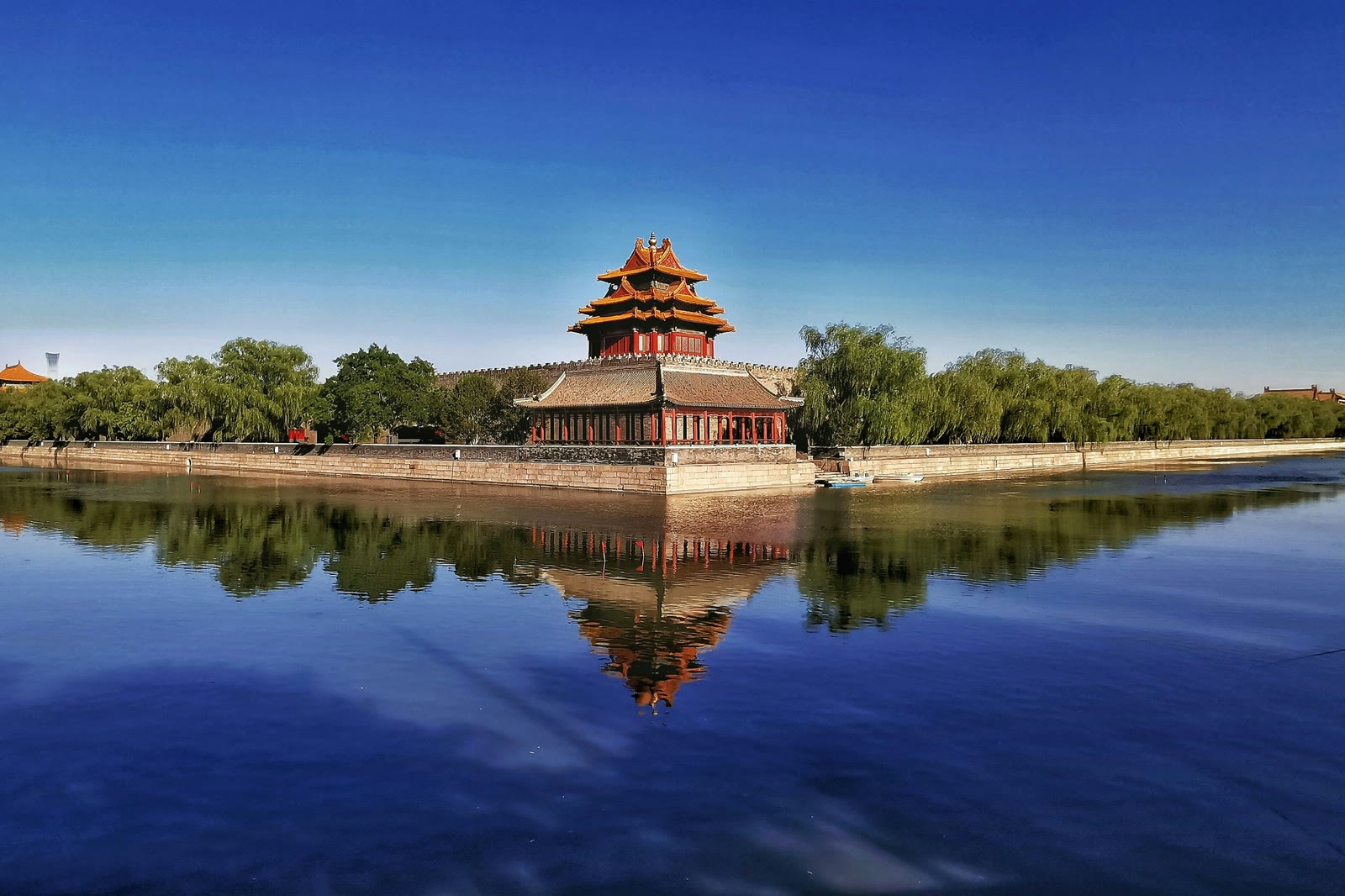
Beijing in 4 Days: A Practical Itinerary
The Forbidden City and Jingshan's view, the Lama Temple and hutongs, a full day on the Great Wall at Mutianyu, and the Temple of Heaven and Tiananmen — a four-day Beijing plan with real stops, Chinese names for taxis, the bookings you must make, budgets and the things to know.
Beijing is enormous, and almost everything worth seeing needs a little planning: the Forbidden City sells out days ahead and closes on Mondays, Tiananmen Square and the National Museum need free real-name reservations with your passport, and the Great Wall is a full day out. Four days is the sweet spot to do the essentials properly without racing across the city.
This plan takes one area cluster a day — the Lama Temple and the hutongs around the Drum Tower, the Forbidden City with Jingshan and Beihai, the Wall at Mutianyu, then the Temple of Heaven, Qianmen and Tiananmen at sunset — with a Peking duck dinner, Bib Gourmand noodles and halal mutton hotpot along the way. Every stop has its Chinese name and a Maps link, and the booking windows are spelled out so nobody gets turned away at the gate.
At a glance
Your day-by-day Beijing route
A 4-day Beijing route
Hutongs and the Lama Temple, the Forbidden City and Jingshan, the Great Wall at Mutianyu, then the Temple of Heaven, the National Museum and Tiananmen — one cluster a day, with the timed bookings kept off your arrival day.
The classic first visit, one area cluster per day: hutongs and the Lama Temple, the Forbidden City and Jingshan, a full day on the Great Wall, then the Temple of Heaven, the National Museum and Tiananmen at sunset — central and departure-friendly. The Summer Palace is the optional extra (see the 5-day route).
Day 1Lama Temple, hutong lanes and the Houhai lakes
- Lama Temple (Yonghe Temple)Lama Temple & Guozijian
- Wudaoying HutongLama Temple & Guozijian
- Pang Mei Noodles (Xiang'er Hutong) Bib Gourmand ’26Lama Temple & Guozijian
- Drum and Bell TowersShichahai & Gulou
- Nanluoguxiang hutong laneShichahai & Gulou
- Kaorouji (Yinding Bridge)Shichahai & Gulou
- Shichahai & Houhai lakesShichahai & Gulou
If it rains The Lama Temple's halls and the Drum Tower are under cover; on a wet afternoon swap Nanluoguxiang and Houhai for a long copper-pot hotpot at Man Heng Ji and the malls on Wangfujing.
Add if you have time Add the Confucius Temple and Imperial College, 300 m from the Lama Temple (closed Mondays), or book King's Joy on Wudaoying Hutong for a two-star vegetarian dinner.
Day 2Forbidden City, Jingshan's view and Beihai, then Peking duck
- Forbidden City (Palace Museum)Forbidden City & Jingshan
- Jingshan ParkForbidden City & Jingshan
- No. 69 Fangzhuanchang Zhajiangmian Bib Gourmand ’26Shichahai & Gulou
- Beihai ParkBeihai
- Siji Minfu Roast Duck (Forbidden City branch)Nanchizi Street (by the Forbidden City's Donghua Gate)
- Wangfujing StreetWangfujing
If it rains The Forbidden City's Treasure Gallery and Clock Gallery are indoors; skip Jingshan and Beihai and spend the afternoon in the National Museum (not Mondays; book 7 days ahead) or the APM mall on Wangfujing.
Add if you have time Leave Beihai by the north gate for Prince Gong's Mansion (book 10 days ahead; closed Mondays), or swap the duck dinner for MICHELIN-starred DaDong.
Day 3Great Wall at Mutianyu
- Great Wall at MutianyuDay trip
- Great Wall at MutianyuDay trip
- Hu Da (Guijie flagship)Guijie (Ghost Street, Beixinqiao end)
If it rains The Wall is fully exposed and slippery in rain (and closes in storms). On a wet day swap it with a city day — the National Museum or Capital Museum (book ahead) — and move Mutianyu to the next dry day.
Add if you have time Ride the chairlift up and the toboggan down near Tower 6 (¥140 combo), or take the high-speed train to Badaling instead if you'd rather not spend 3 hours in a car.
Day 4Temple of Heaven, Qianmen, the National Museum and Tiananmen at sunset
- Temple of HeavenTemple of Heaven
- Qianmen Street & DashilarQianmen & Dashilar
- Duyichu Shaomai (Qianmen)Qianmen & Dashilar
- National Museum of ChinaTiananmen
- Tiananmen SquareTiananmen
- Bianyifang (Xianyukou branch)Qianmen & Dashilar
If it rains Stay longer in the National Museum (indoors, lifts, cafés); at the Temple of Heaven the halls and the long corridor give some cover, or swap the morning for the Capital Museum.
Add if you have time Add the Mao Memorial Hall before 12:00 (Tuesday–Sunday; book 1–6 days ahead; no bags or cameras) — it stands just north of Qianmen — or walk the Legation Quarter (Dongjiaominxiang) from the square's south-east corner.
Route last checked 2026-10-03 — verify hours and bookings before you go.
Want this as an interactive guide you can reshape by length, budget and pace — with the maps, food and a one-tap PDF?
Get the Beijing Destination Pass · S$9.90 Or build a free planWhere to stay in Beijing
Stay inside the Second Ring Road (or in Sanlitun just outside it) within a few minutes' walk of a metro station — Beijing is too big to commute from the edges. Courtyard (四合院) hotels in the hutongs are the most atmospheric option, but rooms are small and cars often can't reach the door. Every hotel registers foreign guests with the police at check-in, so have your passport ready; a few small budget hotels still aren't licensed to take foreigners — book listings that say they accept foreign passports. Prices are estimates and jump during Golden Week (1–7 Oct), Labour Day (1–5 May) and around Lunar New Year.
Wangfujing / Dongdan
First-timers, convenience
Dongsi / Nanluoguxiang
Hutong atmosphere, couples
Qianmen
Value, train connections
Sanlitun / Chaoyang
Nightlife, design hotels, Capital Airport access
Beixinqiao / Dongzhimen
Airport Express, late-night food
By budget
- Budget — S$38–76 · Hostels and courtyard hostels, Budget chain hotels (check they accept foreign passports)
- Mid-range — S$95–190 · 3–4 star and international mid-range chains, Hutong courtyard boutique hotels
- Comfortable — S$285–760+ · 5-star hotels, Luxury courtyard hotels near the Forbidden City
- Check that the listing accepts foreign (non-mainland) guests and that the name on the booking matches your passport.
- Ask the hotel to write its name and address in Chinese, and save it on your phone for DiDi and taxis.
- In hutong hotels, confirm where a car can drop you and how far you'll wheel your luggage.
Prices and availability change constantly. Confirm current rates, and that the hotel accepts foreign passports, on the hotel or a booking site before paying.
What to budget for Beijing
Per person, per day, excluding flights. A rough guide only — your costs depend on season, area and pace.
Budget
- Accommodation: Hostel or budget chain hotel near a metro line that accepts foreign passports (¥200–400 a night).
- Meals: Jianbing and baozi breakfasts, Bib Gourmand noodles and dumplings, hutong snacks (¥15–50 a meal).
- Transport: Metro with a tapped Visa/Mastercard or the Alipay ride code (¥3–7 a ride); the Qianmen tourist bus or bus 916 to Mutianyu.
- Attractions: Forbidden City ¥40–60, Temple of Heaven combo ¥28–34, Lama Temple ¥25, Summer Palace ¥20–30, Mutianyu ¥55 with the shuttle; the National Museum is free (book).
- Evening: Houhai lakeside, Qianmen and Wangfujing at night and the lit Olympic Green — all free.
Mid-range
- Accommodation: 3–4 star hotel or hutong courtyard boutique hotel in Dongcheng (¥500–1,000 a night).
- Meals: One Peking duck dinner (about ¥150–300 a person), Bib Gourmand hotpot and noodles (¥40–150).
- Transport: Metro plus DiDi between areas; DiDi to Mutianyu roughly ¥200–300 each way (agree the return pick-up), or the cable car up (¥140 return).
- Attractions: Combo tickets at the Temple of Heaven and Summer Palace, the Forbidden City's Treasure Gallery, the Mutianyu cable car or toboggan.
- Evening: A Peking opera at the Liyuan Theatre (¥280–580) or the Chaoyang Theatre acrobatics (from ¥280), then Houhai or Sanlitun.
Comfortable
- Accommodation: 5-star hotel or luxury courtyard hotel near the Forbidden City (¥1,500–4,000+ a night).
- Meals: MICHELIN-starred duck at Sheng Yong Xing or DaDong and the two-star vegetarian tasting at King's Joy (¥400–1,000+ a person).
- Transport: A private car with driver for the Great Wall and Summer Palace days (roughly ¥600–900 a day); DiDi in town.
- Attractions: A private English-speaking guide for the Forbidden City (tip about ¥100–200 a day), the Mutianyu cable car, boats on Kunming Lake.
- Evening: Front-row seats at the opera or acrobatics, then a rooftop bar in Sanlitun or a hotel bar with a CBD view.
When to visit Beijing
Weather, daylight, air quality and seasonal events vary year to year. Treat this as general guidance and check a forecast and the daily AQI close to your dates.
Winter Dec, Jan, Feb
Cold and very dry: daytime highs around 0–5°C and nights around −5 to −10°C; colder and windier on the Great Wall.
Do outdoor sights between 10:00 and 15:00 when it is warmest, and keep museums (National Museum, Capital Museum) for late afternoons. Haze is more frequent in the heating season — check the AQI and plan the Wall and Jingshan's view for clear, windy days.
Look out for: Frozen-lake skating at Shichahai and the Summer Palace, Lunar New Year temple fairs, Snow on the Forbidden City's roofs
Spring Mar, Apr, May
Warming fast: about 5–15°C in March to 20–28°C by late May; dry and often windy.
On dusty or windy days, swap the Great Wall or Jingshan for the National Museum or Capital Museum; carry a mask and sunglasses.
Look out for: Plum, magnolia, peach and cherry blossoms in the parks (late March–April), Tulips at Zhongshan Park
Summer Jun, Jul, Aug
Hot and often humid: highs about 30–35°C, sometimes hotter.
Shift sightseeing to 07:00–11:00 and after 16:00; use the air-conditioned museums and malls at midday; have a museum ready for thunderstorm afternoons.
Look out for: Lotus in bloom at Beihai, Shichahai and the Old Summer Palace, Long evenings at Houhai
Autumn Sep, Oct, Nov
Beijing's best season: clear, dry days — about 18–27°C in September, 9–20°C in October and −1 to 10°C in November.
Avoid the Golden Week dates if you can. From mid-November the heating season starts and haze days become more common — keep a museum day flexible.
Look out for: Autumn colours at Mutianyu (best mid-October to early November), Red leaves at Fragrant Hills, Golden ginkgo avenues in November
Common Beijing mistakes to avoid
- Trying to buy Forbidden City tickets on the day. There are no gate sales: tickets release 7 days ahead at 20:00 and sell out, and the palace is closed on Mondays except public holidays.
- Skipping the Tiananmen Square and National Museum reservations. Both are free but need real-name booking with your passport (the museum releases slots daily at 17:00 for 7 days ahead and closes on Mondays).
- Visiting the Temple of Heaven on a Monday and finding the Hall of Prayer shut. The park opens daily, but the three halls close on Mondays (except public holidays and 15 Jul–31 Aug). The Summer Palace's inner gardens close on Mondays too.
- Buying the park-only ticket at the Temple of Heaven or Summer Palace. Buy the combo (联票) to get into the main halls.
- Doing the Great Wall on the arrival or departure day. Mutianyu is a full day including about 1.5 hours each way; put it mid-trip and book real-name tickets with your passport.
- Booking a 'Badaling' train to the wrong station. High-speed trains go to Badaling Great Wall station (八达岭长城站) from Qinghe or Beijing North; boarding gates close 12 minutes before departure there.
- Arriving without Alipay or WeChat Pay set up and tested. Link your card, verify your passport, make a test payment in Singapore and warn your bank — first foreign transactions are often blocked as fraud.
- Letting your Singapore SIM lapse or switching it off. Alipay, WeChat, DiDi and your bank send one-time passwords to your +65 number. Use dual SIM: eSIM for data, Singapore SIM for SMS.
- Relying on hotel Wi-Fi or a local SIM for Google, Instagram, WhatsApp or YouTube uploads. These are filtered; use roaming or a travel eSIM with HK/SG breakout. Don't count on a VPN.
- Assuming Changi Pay still works in China. Its overseas QR payments ended on 1 Oct 2026. Use a card linked to Alipay or WeChat, DBS Remit to a Weixin Pay wallet, or OCBC Scan & Pay.
- Pasting Google Maps coordinates into Amap or Baidu without converting them. China's maps use an offset datum, so the pin lands 100–700 m off — about 555 m at the Forbidden City. Search by the Chinese name instead (every stop in this guide has one).
- Booking with a name or passport number that doesn't exactly match the passport you carry — palace, museum, Great Wall and train tickets are all real-name.
- Joining the Siji Minfu queue at 18:30 on a weekend. Take a number in the afternoon on Dianping/Meituan, or eat at Bianyifang or another branch.
- Accepting invitations to tea, a bar, a massage or an 'art student' gallery from friendly strangers around Wangfujing, Tiananmen and Houhai — the bill can run to thousands of yuan.
- Arriving at Beijing South or West 15 minutes before a high-speed train. Security queues are long, gates close 2–7 minutes before departure (12 at Badaling), and Beijing has several similarly named stations.
- Paying large bills through Alipay or WeChat with a foreign card (3% fee above ¥200) when the hotel or mall takes the card directly.
- Carrying only ¥100 notes. Change can be short, and counterfeit ¥100 notes circulate.
- Staying in an Airbnb or private home without registering with the local police within 24 hours (hotels do it for you at check-in).
- Miscounting the 30 visa-free days. Days run from the day after arrival; keep a buffer, and repeat visitors should watch the 90-days-in-180 cap.
- Flying a drone in Beijing. Flying is effectively banned inside the 6th Ring Road, and new drones need CAAC real-name registration and activation (since 1 May 2026).
- Bringing a power bank without a clear 3C (CCC) mark, or from a recalled batch, onto a domestic Chinese flight, or using one to charge devices in flight.
Good to know in Beijing
Getting around
- The metro covers every city sight in this guide; Lines 1, 2, 5, 6, 8 and 10 do most of the work. Trains run roughly 05:00–23:00 (varies by line).
- Walk within an area and ride between areas — Beijing's blocks are long, and Tiananmen Square alone is 880 m.
- DiDi is cheap and quick off-peak; avoid 07:30–09:30 and 17:00–19:30 on the ring roads.
- Use Amap (高德) for routes, station exits and walking directions; Google Maps is blocked on Chinese networks and its China map is offset from the GPS dot.
- For the Great Wall at Mutianyu, take DiDi or a private car (about 1.5 hours; agree the return pick-up), the direct tourist bus from Qianmen (Beijing Tourist Distribution Center; departures 07:30–10:30, returns 14:30–16:30), or bus 916 express from Dongzhimen to Huairou Beidajie and a local bus on.
Tap a contactless bank card at any metro gate — Visa and Mastercard have worked at every gate on the whole network, airport lines included, since 13 Sep 2024, and JCB and Amex since June 2025 (turn o…
Money & connectivity
- Alipay and WeChat Pay (Weixin Pay) with a Singapore Visa, Mastercard, Amex, JCB, Diners or Discover card linked are how Beijing pays — street stalls, hutong snack shops, taxis and vending machines take QR codes or cash only. Set up in Singapore: register both with your +65 number, link your card, complete passport verification and make a small test payment; a new WeChat account may need an existing user to verify it, so start early, and warn your bank (first foreign transactions are often blocked as fraud). Fees: WeChat Pay charges nothing on single payments under ¥200 and 3% above (new international-card users get 60 days fee-free under ¥1,000, capped at ¥30 saved per payment — Beijing government, 26 Mar 2026); Alipay is free at ¥200 or less and 3% of the whole amount above ¥200 (¥250 costs ¥7.50); your card's foreign-currency fee (about 3–3.5% on Singapore cards) comes on top. Limits for visitors: US$5,000 per transaction, US$50,000 a year. Singapore options: DBS Remit can fund your own Weixin Pay wallet balance with no fees (since 5 Jun 2026), which avoids the 3% card charge; since 9 Feb 2026 the OCBC app can scan Weixin Pay, Alipay+ and UnionPay merchant QR codes with no additional OCBC fees. Changi Pay stopped overseas Alipay/Alipay+ QR payments on 1 Oct 2026. GO BEIJING in Alipay has a zero-fee 'travel wallet'; Tencent's TenPayGo (launched 24 Sep 2026) is brand new — a backup only. Alipay TourCard is gone; link your card directly. Cards work at star-rated hotels, big malls, A-level attractions, the metro gates, 12306, Trip.com and DiDi — pay large hotel or mall bills by card to avoid the 3% wallet fee. Cash: carry ¥500–1,000 in ¥10/¥20/¥50 notes plus a few ¥100s; since 1 Feb 2026 face-to-face businesses must accept RMB cash and keep change, but change can still be short. Bank of China ATMs are the most reliable (English menus, about ¥20–30 local fee, roughly ¥2,500–3,000 per withdrawal); use machines inside branches. Counterfeit ¥100 notes circulate, even from ATMs.
- Chinese networks (local SIM, hotel and café Wi-Fi) block Google (Search, Gmail, Maps, Drive, YouTube, online Translate), WhatsApp, Telegram, Signal, Facebook, Instagram, Threads, X, many Western news sites, ChatGPT, Claude and Gemini; international TikTok doesn't work (the local version is Douyin). Options: (1) Singapore roaming (Singtel, StarHub, M1) — data routes home, so blocked apps work and SMS one-time passwords keep arriving; simplest but dearer. (2) A travel eSIM with Hong Kong or Singapore breakout (look for 'HK/SG breakout' or 'no VPN needed'). (3) A China Mobile, Unicom or Telecom SIM bought with your physical passport at an airport counter (about ¥100–200 for 30 days, per third-party guides) — fast and cheap but fully filtered; carrier eSIMs need a Chinese ID. Only government-licensed VPNs are legal and consumer VPNs are unreliable, so don't depend on one. Use dual SIM: eSIM for data, Singapore SIM for SMS. Install before you fly: Alipay, WeChat, Amap (English since Jan 2025, 16 languages; 'Amap Global'), DiDi, Railway 12306 and Trip.com, NIA 12367, a translator with offline packs, RedNote/Xiaohongshu and Dianping, and your bank's app with overseas use switched on. Apple Maps works without a VPN. Content creators: hotel Wi-Fi won't upload to Instagram, TikTok or YouTube — budget roaming or eSIM data.
- Tipping is not customary in mainland China — restaurants, taxis and hotels don't expect it, and staff may be confused if you try. Upscale hotel restaurants may add a 10–15% service charge; don't add more. Exceptions: private tour guides about ¥100–200 a day per group, private drivers (for example a Great Wall day) about ¥50–100 a day per group, porters ¥10–20 (optional). Give tips in cash, with both hands.
Local etiquette
- Your passport is your ID for everything — hotels, trains, the Forbidden City, museums, Tiananmen Square, the Great Wall, SIM cards and some lockers. Carry the physical passport, not a photo; anyone over 16 must carry it at all times.
- Mandarin is spoken everywhere and Beijing's accent is the standard; the script is Simplified Chinese, the same as Singapore, so Mandarin-speaking Singaporeans have a big advantage. Listen for the Beijing 'er' sound at the end of words (哪儿, 胡同儿).
- Security is part of daily life around Tiananmen and Chang'an Avenue: ID checks, bag X-rays and roped-off areas. Follow instructions, don't film police, soldiers or checkpoints, and don't join or photograph protests.
- Ordering by QR code is standard: scan the table code to order and pay. Ask for a paper menu (纸质菜单) if your apps fail.
Police: 110 · Ambulance: 120 (Beijing Red Cross emergency line: 999) · Fire: 119 · Traffic accidents: 122 · Directory: 114 · China Immigration Service hotline (visas, arrival card, stays): 12367 · City government hotline: 12345 · Embassy of Singapore in Beijing: No. 1 Xiu Shui Bei Jie, Jianguomenwai, Chaoyang (北京市朝阳区建国门外秀水北街1号) · +86-10-6532 1115 · MFA 24-hour Consular Response Centre: +65 6379 8800 (mfa_duty_officer@mfa.gov.sg) · Lost passport: report to the local police or Exit-Entry bureau; report to ICA online with Singpass (you can apply for a new passport one working day later) or go to the Embassy with the police report, a photo and proof of citizenship (NRIC or driving licence) for a new passport or a Document of Identity; then get a Chinese Exit Permit from the Exit-Entry bureau (normally about 5 working days). · eRegister your trip at eregister.mfa.gov.sg before you fly. · Air quality: check the daily AQI (english.mee.gov.cn, aqicn.org or IQAir), especially once the heating season starts around 15 Nov; pack N95/KN95 masks if you are sensitive. · Tap water is not safe to drink — drink bottled or boiled water. · Keep your hotel address in Chinese characters for taxis and DiDi.
Beijing — frequently asked questions
Is 4 days enough for Beijing?
4–5 days is the usual recommendation for Beijing. The plan here runs to 4 days, and the full guide builds routes from 2–6 days — so you can shorten or extend it to fit your trip.
What food is Beijing known for?
Beijing's highlights include Siji Minfu Roast Duck (Forbidden City branch), Quanjude (Qianmen flagship), Bianyifang (Xianyukou branch), Sheng Yong Xing (Chaoyang), Gastro Esthetics DaDong (Nanxincang) and more. Each is linked to Google Maps in the route above; famous spots queue at peak times, so go off-peak or pick a neighbouring stall.
Where should I stay in Beijing?
Good bases include Wangfujing / Dongdan (First-timers, convenience); Dongsi / Nanluoguxiang (Hutong atmosphere, couples); Qianmen (Value, train connections). See "Where to stay" above for the full breakdown by budget.
How much does Beijing cost per day?
Roughly around S$80–120 a day on a budget, S$170–260 mid-range, S$350–650 comfortable per person, excluding flights and accommodation swings. See "Budget" above for what each tier covers.
When is the best time to visit Beijing?
Weather, daylight, air quality and seasonal events vary year to year. Treat this as general guidance and check a forecast and the daily AQI close to your dates. See "When to go" above for the month-by-month detail.
Do Singaporeans need a visa for China?
Singapore ordinary passports need no visa for China: the China–Singapore mutual visa-exemption agreement (in force since 9 Feb 2024, still listed by MFA PRC in May 2026 and confirmed by ICA and MFA SG) allows up to 30 days per entry for tourism, visiting relatives, business meetings and other private purposes. Days count from 00:00 on the day after you arrive to 24:00 on day 30 (arrive 1 Nov, leave by 23:59 on 1 Dec) — keep a day in hand. Work, news reporting and paid or commissioned shoots still need a visa; personal travel vlogging is generally treated as tourism. For more than 30 days, get a visa first; repeat visitors should treat 90 days in any 180 as a working cap. Your passport must be valid for the whole stay (6 months is the safe norm because airlines may check). Since 20 Nov 2025 you can fill in the arrival card online before travel (NIA website s.nia.gov.cn/ArrivalCardFillingPC/, the 'NIA 12367' app, or the WeChat/Alipay mini-program), or use the kiosks, QR codes or paper cards in the hall. Expect a face photo and possibly fingerprints; have your return ticket and first hotel on your phone. The health declaration was abolished on 1 Nov 2023. Declare cash over RMB 20,000 or foreign currency over US$5,000. Hotels register you with the police at check-in; in private lodging you or your host must register within 24 hours. Rules change — confirm on the ICA, MFA Singapore and NIA websites before you fly.
Plan Beijing your way
Start free, or get the complete interactive guide — maps, food, day-by-day routes you can reshape, and a one-tap PDF.