
Shenzhen in 2 Days: A Practical Itinerary
Dongmen and the Huaqiangbei electronics market, Deng Xiaoping's statue on Lianhuashan and the 116th-floor Free Sky deck, then OCT-LOFT, the walled Nantou Ancient Town, Shekou and the Shenzhen Bay skyline — a practical two-day Shenzhen plan with Chinese names for taxi drivers, MICHELIN-listed food, budgets, Hong Kong border tips and the China setup to do before you fly.
Shenzhen is about four hours from Singapore by direct flight — or a short MTR or high-speed train ride from Hong Kong — and visa-free for Singapore passports for up to 30 days. A largely rural border county when it became a city in 1979 and China's first Special Economic Zone in 1980, it is now a city of around 18 million: the place to see what modern China builds, from the supertall towers of Futian to the gadget stalls of Huaqiangbei, with Cantonese, Chaoshan and Hakka cooking that Singaporeans will recognise, and a first MICHELIN selection published in August 2026.
Two days covers both halves of the city along the metro. Day one runs east to west from Luohu, where the Lo Wu crossing from Hong Kong lands, through Huaqiangbei to the Lianhuashan summit and the Free Sky deck at sunset — nothing on it closes on Mondays or needs booking days ahead. Day two is Nanshan: OCT's creative park, the walled Nantou Ancient Town, Shekou's waterfront and the Shenzhen Bay skyline at night, ending near the airport line, Shenzhen Bay Port and the Shekou ferry to Hong Kong airport. Every stop carries its Chinese name and address for drivers and Amap. Set up Alipay or WeChat Pay and a roaming plan or HK/SG-breakout eSIM before you fly — and since September 2026 you can simply tap your Singapore card at every metro gate.
At a glance
Your day-by-day Shenzhen route
A 2-day Shenzhen route
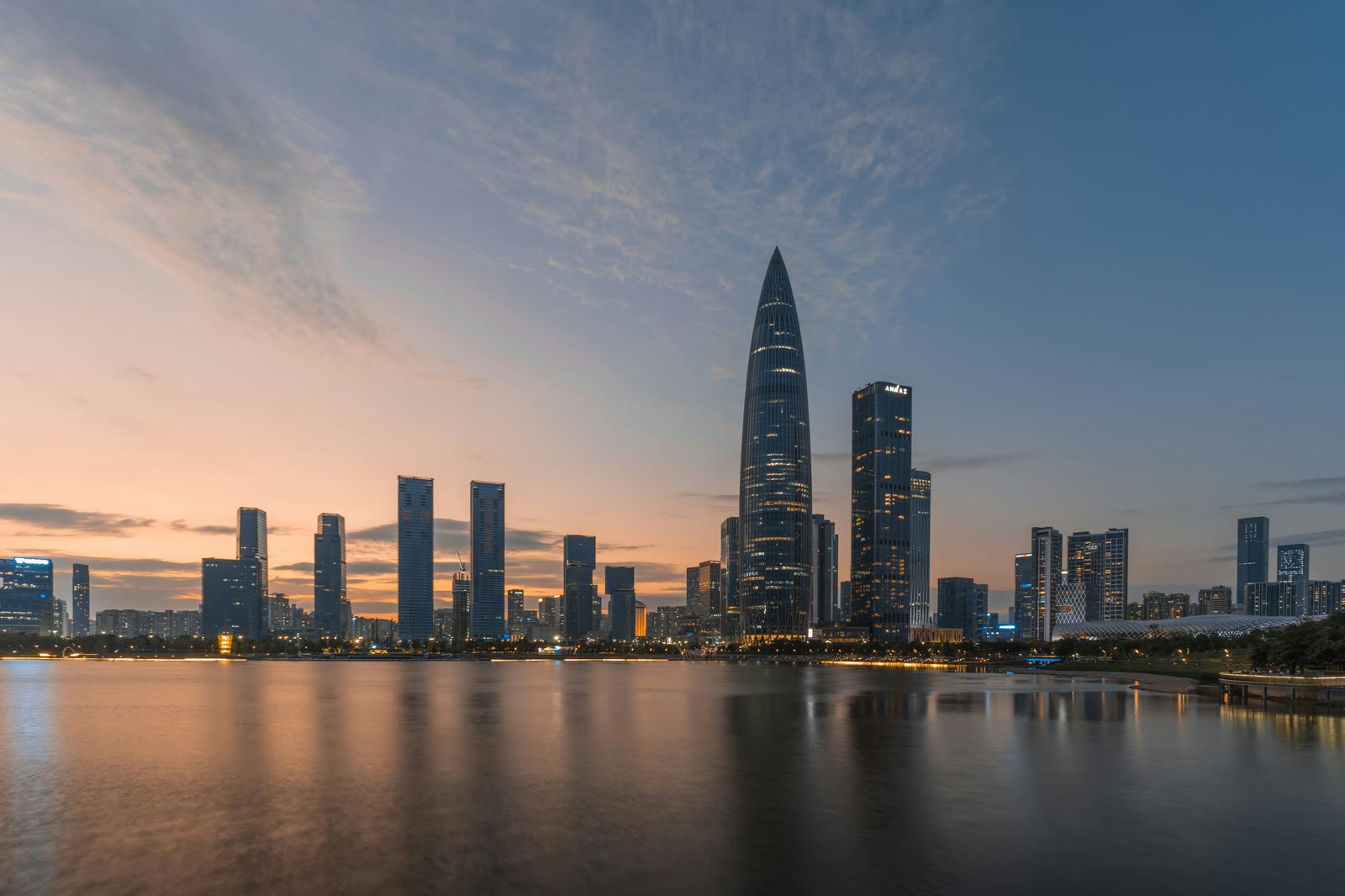
Dongmen, Huaqiangbei, Lianhuashan and the Free Sky deck on day one; OCT-LOFT, Nantou Ancient Town, Shekou and the Talent Park skyline on day two — one half of the city a day along the metro.
Two halves of the city on the metro. Day 1 runs east to west from Luohu, where the Lo Wu crossing from Hong Kong lands — Dongmen, Huaqiangbei, the Lianhuashan summit and the Free Sky deck at sunset, then the CBD after dark — and nothing on it closes on Mondays or needs booking days ahead. Day 2 is Nanshan: OCT Harbour and OCT-LOFT, the walled Nantou Ancient Town, Shekou's Design Society and Sea World, and the Shenzhen Bay skyline from Talent Park — ending near Line 11 to the airport, Shenzhen Bay Port and the Shekou ferry.
Day 1Old Luohu to the Futian skyline — Dongmen, Huaqiangbei, Deng's hill and the 116th floor
- Phoenix House (Huaqiang branch)Huaqiangbei
- Da Tang Liang Tang Bib Gourmand ’26Futian CBD
If it rains Dongmen's malls, Huaqiangbei's market floors and the Free Sky deck are indoors (skip the deck if low cloud hides the view). Swap the Lianhuashan climb for the Shenzhen Museum's ceramics and bronzes on Tongxin Road or its history galleries at the Civic Center (both closed Mondays), and the light show (cancelled in rain) for the covered terraces of Upperhills LOFT.
Add if you have time Crossing at Lo Wu with time to spare? Browse Luohu Commercial City at the border (10:00–22:00) before Dongmen. On a Friday or Saturday, book a Civic Square light-show slot 3 days ahead, or watch free from the Lianhuashan summit.
Day 2OCT, Nantou, Shekou and the Shenzhen Bay skyline
- OCT Harbour (Happy Coast)OCT (Overseas Chinese Town)
- OCT-LOFT Creative Culture ParkOCT (Overseas Chinese Town)
- Runyuan Siji coconut-chicken hotpot (OCT-LOFT flagship)OCT (Overseas Chinese Town)
- Xin Ji Ke Jia Wei Dao Bib Gourmand ’26Shekou
- Sea World, Shekou (Minghua ship & music fountain)Shekou
- Shenzhen Talent Park (Shenzhen Bay night skyline)Houhai & Shenzhen Bay
If it rains OCT-LOFT's galleries and cafés and the Design Society are indoors. Swap OCT Harbour's promenade for the He Xiangning Art Museum, Nantou's lanes for the Shenzhen Bay Culture Square design museum (both closed Mondays; the square is at Line 13 Talent Park), and the evening waterfronts for the Shenzhen Bay MixC mall at Houhai.
Add if you have time Travelling with children? Spend the morning at Window of the World instead (¥220; opens 09:30) and pick the route up at Nantou after lunch. With two-star Yun Jing booked, take dinner on the 70th floor of the Raffles before the Talent Park skyline.
Route last checked 2026-10-03 — verify hours and bookings before you go.
With a third day
Add Metro Line 3 north to the Hehu Xinju Hakka walled village and the Dafen painters' village, then the Shenzhen Museum and the reform-era exhibition at the Civic Center (closed Mondays).
Day 1 is Luohu and Futian (open on Mondays and free of advance bookings, so it suits an arrival day). Day 2 rides Metro Line 3 out to the Hehu Xinju Hakka walled village and the Dafen painters' village, then back to the Civic Center for the Shenzhen Museum and the reform-era exhibition — all three close on Mondays, so swap Days 2 and 3 if Day 2 is a Monday. Day 3 is Nanshan — OCT, Nantou, Shekou and the bay — close to Line 11 to the airport, Shenzhen Bay Port and the Shekou ferry for departure.
Day 1Old Luohu to the Futian skyline — Dongmen, Huaqiangbei, Deng's hill and the 116th floor
- Phoenix House (Huaqiang branch)Huaqiangbei
- Da Tang Liang Tang Bib Gourmand ’26Futian CBD
If it rains Dongmen's malls, Huaqiangbei's market floors and the Free Sky deck are indoors (skip the deck if low cloud hides the view). Swap the Lianhuashan climb for the Shenzhen Museum's ceramics and bronzes on Tongxin Road or its history galleries at the Civic Center (both closed Mondays), and the light show (cancelled in rain) for the covered terraces of Upperhills LOFT.
Add if you have time Crossing at Lo Wu with time to spare? Browse Luohu Commercial City at the border (10:00–22:00) before Dongmen. On a Friday or Saturday, book a Civic Square light-show slot 3 days ahead, or watch free from the Lianhuashan summit.
Day 2Line 3 north — a Hakka walled village, the painters' village and the story of Shenzhen
- Hehu Xinju Hakka walled village (Longgang Hakka Folk Museum)Longgang
- Dafen Oil Painting VillageDafen (Longgang)
- Ge Ji Mei Ji Xian Bib Gourmand ’26Luohu (Hongling)
- Xingning Ke Jia Cai Guan (Meicun Road) Bib Gourmand ’26Futian north (Meilin)
- Upperhills LOFTFutian north
If it rains Almost everything is indoors or under cover — Hehu Xinju's halls and corridors, Dafen's studios, the two museums and Upperhills' malls. Take DiDi from the stations if it pours.
Add if you have time Paint your own small canvas at a Dafen studio (some run short sessions from about ¥30), or swap the museums for Fairy Lake Botanical Garden and Hongfa Temple (¥15 WeChat e-ticket) in the afternoon.
Day 3OCT, Nantou, Shekou and the Shenzhen Bay skyline (departure-friendly)
- OCT Harbour (Happy Coast)OCT (Overseas Chinese Town)
- OCT-LOFT Creative Culture ParkOCT (Overseas Chinese Town)
- Runyuan Siji coconut-chicken hotpot (OCT-LOFT flagship)OCT (Overseas Chinese Town)
- Xin Ji Ke Jia Wei Dao Bib Gourmand ’26Shekou
- Sea World, Shekou (Minghua ship & music fountain)Shekou
- Shenzhen Talent Park (Shenzhen Bay night skyline)Houhai & Shenzhen Bay
If it rains OCT-LOFT's galleries and cafés and the Design Society are indoors. Swap OCT Harbour's promenade for the He Xiangning Art Museum, Nantou's lanes for the Shenzhen Bay Culture Square design museum (both closed Mondays; the square is at Line 13 Talent Park), and the evening waterfronts for the Shenzhen Bay MixC mall at Houhai.
Add if you have time Travelling with children? Spend the morning at Window of the World instead (¥220; opens 09:30) and pick the route up at Nantou after lunch. With two-star Yun Jing booked, take dinner on the 70th floor of the Raffles before the Talent Park skyline.
Route last checked 2026-10-03 — verify hours and bookings before you go.
Short on time: 1 day
Lianhuashan, Huaqiangbei, dim sum, the Free Sky deck, OCT-LOFT and coconut-chicken hotpot, then Talent Park after dark.
The true highlights in one day, east to west along Metro Lines 1–3 and Shennan Avenue: the Deng Xiaoping statue on Lianhuashan and the gadget floors of Huaqiangbei in the morning, dim sum on Huaqiang North Road, the 116th-floor Free Sky deck and OCT-LOFT in the afternoon, Shenzhen's own coconut-chicken hotpot in OCT and the Shenzhen Bay skyline from Talent Park after dark. Nothing on it closes on Mondays, and nothing needs booking days ahead.
Day 1Shenzhen in a day — Deng's hill, the gadget market, the 116th floor and the bay at night
- Phoenix House (Huaqiang branch)Huaqiangbei
- Free Sky observation deck, Ping An Finance CentreFutian CBD
- OCT-LOFT Creative Culture ParkOCT (Overseas Chinese Town)
- Runyuan Siji coconut-chicken hotpot (OCT-LOFT flagship)OCT (Overseas Chinese Town)
- Shenzhen Talent Park (Shenzhen Bay night skyline)Houhai & Shenzhen Bay
If it rains Huaqiangbei's market floors and the Free Sky deck are indoors (skip the deck if cloud hides the view). Swap the Lianhuashan climb for the Shenzhen Museum or the Reform and Opening-up Exhibition Hall at the Civic Center (both closed Mondays), and Talent Park for the Shenzhen Bay MixC mall at Houhai; OCT-LOFT's cafés and galleries work in the rain.
Add if you have time On a Friday or Saturday, Talent Park's towers play a light show at 20:00 and 21:00 (19:30 and 20:30 in April–October) — or watch the Futian CBD show from the Lianhuashan summit instead and skip the late trip west.
Route last checked 2026-10-03 — verify hours and bookings before you go.
Want this as an interactive guide you can reshape by length, budget and pace — with the maps, food and a one-tap PDF?
Get the Shenzhen Destination Pass · S$9.90 Or build a free planWhere to stay in Shenzhen
Stay within a few minutes' walk of a metro station — Shenzhen is long and thin, and Luohu (the Lo Wu border) to Shekou is about an hour end to end on the metro. Futian sits in the middle and suits most short trips; Luohu is cheaper and closest to Hong Kong; Houhai and Shekou are handy for the airport, Shenzhen Bay Port and the Shekou ferry. Every hotel registers foreign guests with the police at check-in, so have your passport ready; some small budget hotels still aren't licensed to take foreigners, so book listings that say they accept foreign passports. Prices are estimates and rise at Golden Week (1–7 Oct), Lunar New Year and during big trade fairs.
Futian CBD
First-timers, transport
Luohu (Dongmen / Grand Theater)
Value, Hong Kong access
Huaqiangbei
Gadget shopping, mid-range chains
Houhai / Shenzhen Bay
Modern hotels, the bay skyline
OCT and Shekou
Families, couples, the airport ferry
By budget
- Budget — S$38–76 · Hostels, Budget chain hotels (check they accept foreign passports)
- Mid-range — S$95–190 · 3–4 star and international mid-range chains, Serviced apartments
- Comfortable — S$270–725+ · 5-star hotels with skyline or bay views (Mandarin Oriental, Raffles, Park Hyatt and others)
- Check that the listing accepts foreign (non-mainland) guests and that the name on the booking matches your passport.
- Ask the hotel to write its name and address in Chinese, and save it on your phone for DiDi and taxis.
- Crossing from Hong Kong? Luohu and Futian hotels are a short metro ride from Lo Wu and Futian Port; for the Shekou airport ferry or Shenzhen Bay Port, stay in Houhai or Shekou.
Prices and availability change constantly. Confirm current rates, and that the hotel accepts foreign passports, on the hotel or a booking site before paying.
What to budget for Shenzhen
Per person, per day, excluding flights. A rough guide only — your costs depend on season, area and pace.
Budget
- Accommodation: Hostel or budget chain hotel near a metro station in Luohu or Huaqiangbei that accepts foreign passports (¥200–400 a night).
- Meals: Bib Gourmand noodles and kway teow (¥25–60), rice rolls, Dongmen snacks and Lanzhou beef noodles; one dim sum session.
- Transport: Metro by tapped card or Alipay ride code (¥2–8 a ride); Line 11 from the airport (about ¥7).
- Attractions: Almost everything on the routes is free — Lianhuashan, the Civic Center, Huaqiangbei, OCT-LOFT, Nantou, Sea World, Talent Park and the Shenzhen Museum. Skip the Free Sky deck (¥190) and use the Lianhuashan summit and Talent Park as your free skyline views.
- Evening: Light shows from the Lianhuashan summit or Talent Park (Fridays, Saturdays and holidays), Sea World's fountain, Dongmen at night — all free.
Mid-range
- Accommodation: 3–4 star hotel in Futian, Luohu or Houhai (¥500–1,000 a night).
- Meals: Dim sum at Phoenix House (¥60–100 a head), Chaoshan beef hotpot or coconut-chicken hotpot (¥90–150), Bib Gourmand Hakka and Cantonese dinners (¥60–120).
- Transport: Metro plus DiDi between areas (¥15–40 a ride in town).
- Attractions: The Free Sky deck at sunset (¥190), an exhibition at the Design Society or the Shenzhen Bay Culture Square (from about ¥20).
- Evening: The Futian light show from Civic Square (free booking) or Talent Park, then a drink on the Upperhills LOFT terraces or at Sea World.
Comfortable
- Accommodation: 5-star hotel with a skyline or bay view in Futian, Upperhills or Houhai (¥1,400–3,800+ a night).
- Meals: MICHELIN-starred Cantonese at The Bay (two stars) or Yun Jing (two stars, 70th floor), one-star Chaozhou at Chao Shang Chao (roughly ¥600–2,000+ a head), plus Bib Gourmand lunches.
- Transport: DiDi or a hotel car between areas; a car with driver for the Dapeng and Xichong day (roughly ¥800–1,200).
- Attractions: Free Sky, Design Society and Shenzhen Bay Culture Square exhibitions, a private guide for Nantou and OCT (tip about ¥100–200 a day).
- Evening: Dinner with a view at Yun Jing before the Talent Park light show, then a hotel bar over Shenzhen Bay.
When to visit Shenzhen
Weather, daylight and event dates vary year to year. Treat this as general guidance and check the forecast and typhoon warnings close to your dates.
Winter Dec, Jan, Feb
Mild and dry: average highs of about 20–22°C and lows of 13–15°C, with occasional cold snaps near 8°C. Many older buildings have no heating, so evenings indoors can feel cool.
Bring a light jacket for evenings by the bay; around Lunar New Year, check that family-run restaurants are open.
Look out for: Clear, dry days for the Free Sky deck and the Wutong Mountain hike, Winter birds on the Shenzhen Bay mangroves
Spring Mar, Apr
Warm and increasingly humid, about 17–27°C, with fog and the damp 'return-south' weather (回南天).
Keep a museum or mall in reserve for wet days and check visibility before paying for Free Sky.
Look out for: Hazy days that can hide the skyline, Easter brings Hong Kong crowds north
Summer May, Jun, Jul, Aug, Sep
Hot and humid: highs of 30–32°C and lows of 24–27°C, feeling hotter in the humidity.
Do outdoor sights early, spend midday in museums and malls, and save Talent Park and the bay for evenings. In a typhoon or black rainstorm warning, beaches, parks and the light shows close — stay indoors.
Look out for: Beach season at Dameisha and Xichong, Longer museum hours in July–August
Autumn Oct, Nov
The best season: dry and sunny, about 23–29°C in October and 19–26°C in November.
Avoid Golden Week if you can; otherwise book trains and hotels early and cross the border on weekday mornings.
Look out for: Clear evenings for the light shows and the Free Sky deck, Good hiking weather on Wutong Mountain
Common Shenzhen mistakes to avoid
- Planning museums for a Monday. The Shenzhen Museum (both buildings), the Reform and Opening-up Exhibition Hall, the Hehu Xinju Hakka museum, the He Xiangning Art Museum and the Shenzhen Bay Culture Square are all closed on Mondays; OCT-LOFT's OCAT, Dafen's art museum and the Nantou museum too.
- Expecting the light shows every night. The Futian CBD and Talent Park shows run only on Fridays, Saturdays, public holidays and the evening before (19:00, 20:00, 21:00 from November to March), and are cancelled in rain. Civic Square needs a free booking in the 福田中心区夜景灯光预约导引服务 mini-program, opened 3 days ahead at 10:00; the Lianhuashan summit and Talent Park don't.
- Crossing from Hong Kong on a Saturday morning or going back on a Sunday evening. Northbound and southbound queues at Lo Wu and Futian Port can run for an hour or more at peak times and on Hong Kong holidays. Cross on weekdays or early, and check closing times: Futian Port/Lok Ma Chau 22:30, Lo Wu and Shenzhen Bay midnight, Huanggang (coach or car only) 24 hours.
- Forgetting that re-entering the mainland from Hong Kong is a new entry. You need the arrival card again (online beforehand or at the kiosks and QR codes in the hall), each entry gives up to 30 days, and repeat crossings count towards the 90-days-in-180 cap.
- Going to the wrong station. Shenzhen (Luohu), Shenzhen North, Futian, Shenzhen East and Shenzhen West are different stations, and trains to Hong Kong West Kowloon leave only from some of them (Futian and Shenzhen North are the main ones). High-speed tickets are real-name: the name and passport number must match the passport you carry.
- Turning up at the Shekou ferry 30 minutes before sailing. Check-in closes 60 minutes before departure, you need a same-day flight ticket, and adult economy to the airport is about ¥380 — remember to claim the HK$120 departure-tax refund.
- Buying 'brand' electronics or a power bank at Huaqiangbei without checking. Copies and grey imports are common and warranties rarely work abroad; power banks without a clear 3C (CCC) mark, or from a recalled batch, are banned on Chinese domestic flights.
- Paying for the Free Sky deck in low cloud. Check the view from the street or the forecast first — haze and low cloud can hide everything.
- Arriving without Alipay or WeChat Pay set up and tested. Link your card, verify your passport, make a test payment in Singapore and warn your bank — first foreign transactions are often blocked as fraud.
- Letting your Singapore SIM lapse or switching it off. Alipay, WeChat, DiDi and your bank send one-time passwords to your +65 number. Use dual SIM: eSIM for data, Singapore SIM for SMS.
- Relying on hotel Wi-Fi or a local SIM for Google, Instagram, WhatsApp or YouTube uploads. These are filtered; use roaming or a travel eSIM with HK/SG breakout. Don't count on a VPN.
- Assuming Changi Pay still works in China. Its overseas QR payments ended on 1 Oct 2026. Use a card linked to Alipay or WeChat, DBS Remit to a Weixin Pay wallet, OCBC Scan & Pay — or simply tap your card at the metro gates.
- Pasting Google Maps coordinates into Amap or Baidu without converting them. China's maps use an offset datum, so the pin lands 100–700 m off. Search by the Chinese name instead (every stop in this guide has one).
- Queuing at 19:00 on a Saturday for a Bib Gourmand dai pai dong. Since the August 2026 MICHELIN launch, Hong Kong weekenders fill them — go on a weekday, at 17:30, or after 21:00 for the supper places.
- Booking a cheap hotel that can't register foreigners. Check the listing accepts foreign passports; hotels register you with the police at check-in, and in an Airbnb or private home you must register within 24 hours yourself.
- Paying large bills through Alipay or WeChat with a foreign card (3% fee above ¥200) when the hotel or restaurant takes the card directly.
- Carrying only ¥100 notes. Change can be short, and counterfeit ¥100 notes circulate.
- Accepting invitations to tea, a bar, a massage or an 'art student' gallery from friendly strangers in tourist areas — the bill can run to thousands of yuan.
- Miscounting the 30 visa-free days. Days run from the day after arrival; keep a buffer.
- Flying a drone without CAAC real-name registration and activation (required for new drones since 1 May 2026), or anywhere near the Hong Kong border, the airport or the light-show areas.
Good to know in Shenzhen
Getting around
- The metro covers every city stop in this guide; trains run roughly 06:30–23:00 (later on some lines). Lines 1, 2/8, 3, 11, 12 and 13 do most of the work.
- Luohu to Futian is 10–15 minutes on Line 1; Futian to OCT about 15 minutes; Futian to Shekou about 35 minutes; Futian to Dafen (Line 3) about 35 minutes and to Hehu Xinju about an hour. Group your days by area, as this guide does.
- DiDi is cheap and quick off-peak; avoid 08:00–09:30 and 17:30–19:30 on Shennan Avenue, and expect slow traffic to Dapeng at weekends.
- Use Amap (高德) for routes, station exits and walking directions; Google Maps is blocked on Chinese networks and its China map is offset from the GPS dot.
- Shared bikes are everywhere, but unlocking them with a foreign account is hit-and-miss; walking and the metro are easier for visitors.
Tap a contactless bank card, or a phone wallet with one, at any Shenzhen Metro gate — since 10 Sep 2026 all 17 lines and 432 stations take Visa, Mastercard, Amex, JCB and UnionPay (turn on small no-P…
Money & connectivity
- Alipay and WeChat Pay (Weixin Pay) with a Singapore Visa, Mastercard, Amex, JCB, Diners or Discover card linked are how Shenzhen pays — noodle shops, dai pai dong, Huaqiangbei stalls, taxis and vending machines take QR codes or cash, and many restaurants have you scan the table code to order and pay. Set up in Singapore: register both with your +65 number, link your card, complete passport verification and make a small test payment; a new WeChat account may need an existing user to verify it, so start early, and warn your bank (first foreign transactions are often blocked as fraud). Fees: WeChat Pay charges nothing on single payments under ¥200 and 3% above (new international-card users get 60 days fee-free under ¥1,000, capped at ¥30 saved per payment); Alipay is free at ¥200 or less and 3% of the whole amount above ¥200 (¥250 costs ¥7.50); your card's foreign-currency fee (about 3–3.5% on Singapore cards) comes on top. Limits for visitors: US$5,000 per transaction, US$50,000 a year. Singapore options: DBS Remit can fund your own Weixin Pay wallet balance with no fees (since 5 Jun 2026), which avoids the 3% card charge above ¥200; since 9 Feb 2026 the OCBC app can scan Weixin Pay, Alipay+ and UnionPay merchant QR codes with no additional OCBC fees. Changi Pay stopped overseas Alipay/Alipay+ QR payments on 1 Oct 2026. Tencent's TenPayGo (launched 24 Sep 2026; email sign-up, foreign cards) includes a Shenzhen metro and bus QR, but it is brand new — a backup only. Alipay TourCard is gone; link your card directly. Cards work at star-rated hotels, big malls, A-level attractions such as Window of the World, every metro gate (since Sep 2026), 12306, Trip.com and DiDi — pay large hotel and restaurant bills by card to avoid the 3% wallet fee. Cash: carry ¥500–1,000 in ¥10/¥20/¥50 notes plus a few ¥100s; since 1 Feb 2026 face-to-face businesses must accept RMB cash and keep change, but change can still be short. Bank of China ATMs are the most reliable (English menus, about ¥20–30 local fee, roughly ¥2,500–3,000 per withdrawal); use machines inside branches during opening hours. Counterfeit ¥100 notes circulate, even from ATMs. Hong Kong dollars generally aren't accepted in Shenzhen shops.
- Chinese networks (local SIM, hotel and café Wi-Fi) block Google (Search, Gmail, Maps, Drive, YouTube, online Translate), WhatsApp, Telegram, Signal, Facebook, Instagram, Threads, X, many Western news sites, ChatGPT, Claude and Gemini; international TikTok doesn't work (the local version is Douyin). A Hong Kong SIM roaming in Shenzhen also routes via Hong Kong, so blocked apps work — check its mainland roaming price first. Options: (1) Singapore roaming (Singtel, StarHub, M1) — data routes home, so blocked apps work and SMS one-time passwords keep arriving; simplest but dearer. (2) A travel eSIM with Hong Kong or Singapore breakout (look for 'HK/SG breakout' or 'no VPN needed'); cheap plans that break out locally are filtered. (3) A China Mobile, Unicom or Telecom SIM bought with your physical passport at an airport counter (about ¥100–200 for 30 days, per third-party guides) — fast and cheap but fully filtered; carrier eSIMs need a Chinese ID. Only government-licensed VPNs are legal and consumer VPNs are unreliable, so don't depend on one. Use dual SIM: eSIM for data, Singapore SIM for SMS. Install before you fly: Alipay, WeChat, Amap (English since Jan 2025, 16 languages; 'Amap Global'), DiDi, Railway 12306 and Trip.com, NIA 12367, a translator with offline packs, RedNote/Xiaohongshu and Dianping, and your bank's app with overseas use switched on. Apple Maps works without a VPN. Content creators: hotel Wi-Fi won't upload to Instagram, TikTok or YouTube — budget roaming or eSIM data, or upload back in Singapore.
- Tipping is not customary in mainland China — restaurants, taxis and hotels don't expect it, and staff may be confused if you try. Dim sum houses add a per-person tea charge (茶位费) and upscale hotel restaurants may add a 10–15% service charge; don't add more on top. Exceptions: private tour guides about ¥100–200 a day per group, private drivers about ¥50–100 a day per group, porters ¥10–20 (optional). Give tips in cash, with both hands.
Local etiquette
- Your passport is your ID for everything — hotels, trains, the Shekou ferry, Window of the World tickets, SIM cards and some lockers. Carry the physical passport, not a photo; anyone over 16 must carry it at all times.
- Shenzhen is a young city of migrants, so Mandarin is the common language and you will meet people from every province; Cantonese is understood and common among older locals and Hong Kong visitors. The script is Simplified Chinese, the same as Singapore, so Mandarin-speaking Singaporeans have a big advantage.
- Ordering by QR code is standard: scan the table code to order and pay. Ask for a paper menu (纸质菜单) if your apps fail.
- Spice: Hunanese and Sichuan places are fiery by default — ask for 微辣 (mild) or 不辣 (not spicy). Cantonese, Chaoshan and Hakka food is mild.
Police: 110 · Ambulance: 120 · Fire: 119 · Traffic accidents: 122 · Directory: 114 · China Immigration Service hotline (visas, arrival card, stays): 12367 · City government hotline: 12345 · Consulate-General of Singapore in Guangzhou (covers Guangdong, including Shenzhen): Unit 2418, CITIC Plaza, 233 Tianhe North Road, Guangzhou (广州市天河区天河北路233号中信广场2418室) · +86-20-3891 2345 — about 30 minutes from Shenzhen North by high-speed train · Consulate-General of Singapore in Hong Kong: +852-2527 2212 · MFA 24-hour Consular Response Centre: +65 6379 8800 (mfa_duty_officer@mfa.gov.sg) · Lost passport: report to the local police or Exit-Entry bureau; report to ICA online with Singpass (you can apply for a new passport one working day later) or go to the Consulate-General in Guangzhou with the police report, a photo and proof of citizenship (NRIC or driving licence) for a new passport or a Document of Identity; then get a Chinese Exit Permit from the Exit-Entry bureau (normally about 5 working days). · eRegister your trip at eregister.mfa.gov.sg before you fly. · Weather: typhoons can hit the south coast from May to November (most often July–September) and summer downpours are heavy — follow typhoon and rainstorm warnings; beaches, the light shows and outdoor sights close. · Air quality: usually good to moderate in autumn; check the daily AQI (english.mee.gov.cn, aqicn.org or IQAir) and pack N95/KN95 masks if you are sensitive. · Tap water is not safe to drink — drink bottled or boiled water. · Keep your hotel address in Chinese characters for taxis and DiDi.
Shenzhen — frequently asked questions
Is 2 days enough for Shenzhen?
2 days is the usual recommendation for Shenzhen. The plan here runs to 2 days, and the full guide builds routes from 1–3 days — so you can shorten or extend it to fit your trip.
What food is Shenzhen known for?
Shenzhen's highlights include Phoenix House (Huaqiang branch), Bahe Li Chaoshan beef hotpot (Zhenzhong Road, Huaqiangbei), Da Tang Liang Tang, Runyuan Siji coconut-chicken hotpot (OCT-LOFT flagship), Xin Ji Ke Jia Wei Dao and more. Each is linked to Google Maps in the route above; famous spots queue at peak times, so go off-peak or pick a neighbouring stall.
Where should I stay in Shenzhen?
Good bases include Futian CBD (First-timers, transport); Luohu (Dongmen / Grand Theater) (Value, Hong Kong access); Huaqiangbei (Gadget shopping, mid-range chains). See "Where to stay" above for the full breakdown by budget.
How much does Shenzhen cost per day?
Roughly around S$60–100 a day on a budget, S$130–220 mid-range, S$300–600 comfortable per person, excluding flights and accommodation swings. See "Budget" above for what each tier covers.
When is the best time to visit Shenzhen?
Weather, daylight and event dates vary year to year. Treat this as general guidance and check the forecast and typhoon warnings close to your dates. See "When to go" above for the month-by-month detail.
How do I get from Hong Kong to Shenzhen?
Three easy ways. By MTR: take the East Rail line to Lo Wu (about 45–50 minutes from Admiralty, about HK$52 by Octopus; open 06:30–24:00) or Lok Ma Chau for Futian Port (06:30–22:30), walk through both immigration halls and continue on Shenzhen Metro. By high-speed train: West Kowloon to Futian takes 14–16 minutes (second class from about HK$78), with both border checks at West Kowloon — book real-name tickets on 12306 or Trip.com. From Hong Kong airport: the SkyPier ferry reaches Shekou in about 30 minutes without entering Hong Kong. Each crossing into Shenzhen is a new mainland entry, so fill in the arrival card again, and avoid Saturday-morning and Sunday-evening border peaks.
How do I pay in Shenzhen as a Singaporean?
Mostly by Alipay or WeChat Pay with your Singapore card linked — set both up, verify your passport and make a test payment before you fly, and tell your bank you're travelling. Both wallets are free up to ¥200 and charge 3% above that on foreign cards (plus your card's FX fee), so pay big hotel and restaurant bills by card directly. Since 10 September 2026 every Shenzhen Metro gate takes contactless Visa, Mastercard, Amex, JCB and UnionPay. The OCBC app can scan Weixin Pay, Alipay+ and UnionPay codes, and DBS Remit can top up your own Weixin Pay balance; Changi Pay's overseas QR payments ended on 1 Oct 2026. Shops must accept RMB cash since 1 Feb 2026, so carry ¥500–1,000 in small notes as backup.
Do I need a visa for China?
Singapore ordinary passports need no visa for China: the China–Singapore mutual visa-exemption agreement (in force since 9 Feb 2024, still listed by MFA PRC in May 2026 and confirmed by ICA and MFA SG) allows up to 30 days per entry for tourism, visiting relatives, business meetings and other private purposes. Days count from 00:00 on the day after you arrive to 24:00 on day 30 (arrive 1 Nov, leave by 23:59 on 1 Dec) — keep a day in hand. Work, news reporting and paid or commissioned shoots still need a visa; personal travel vlogging is generally treated as tourism. For more than 30 days, get a visa first. Coming via Hong Kong: Hong Kong runs its own immigration, and every crossing into Shenzhen is a new mainland entry — fill in the arrival card each time and treat 90 days in any 180 as a working cap if you cross repeatedly. Your passport must be valid for the whole stay (6 months is the safe norm because airlines may check). Since 20 Nov 2025 you can fill in the arrival card online before travel (NIA website s.nia.gov.cn/ArrivalCardFillingPC/, the 'NIA 12367' app, or the WeChat/Alipay mini-program), or use the kiosks, QR codes or paper cards in the hall. Expect a face photo and possibly fingerprints; have your return ticket and first hotel on your phone. The health declaration was abolished on 1 Nov 2023. Declare cash over RMB 20,000 or foreign currency over US$5,000. Hotels register you with the police at check-in; in private lodging you or your host must register within 24 hours. Rules change — confirm on the ICA, MFA Singapore and NIA websites before you fly.
Plan Shenzhen your way
Start free, or get the complete interactive guide — maps, food, day-by-day routes you can reshape, and a one-tap PDF.