
Hangzhou in 2 Days: A Practical Itinerary
The island boat and the Bai Causeway, Lingyin Temple at opening, a glass of Dragon Well tea in the hills and Leifeng Pagoda at sunset — a practical two-day Hangzhou plan with Chinese names for taxi drivers, MICHELIN-listed noodles and Hangzhou classics, budgets and the China setup to do before you fly.
Hangzhou is about five hours from Singapore on a direct flight — Singapore Airlines has flown daily since June 2026 and Scoot daily too — or an hour by bullet train from Shanghai, and it is visa-free for Singapore passports for up to 30 days. Two days covers the essentials without rushing: West Lake by boat and on foot, Lingyin Temple's cliff-carved Buddhas, the Dragon Well tea villages and the old-town lanes around Hefang Street.
This plan keeps Day 1 booking-free on the north and east shore, so a late arrival costs nothing, then gives Day 2 to the west: Lingyin at its 07:30 opening (entry has been free since December 2025, but you must book a real-name slot with your passport 1–7 days ahead), tea in Longjing village, the Su Causeway and Leifeng Pagoda for the sunset. A third day adds the Grand Canal and Xixi Wetland on the metro line to the airport. Every stop carries its Chinese name and address for drivers and Amap. Set up Alipay or WeChat Pay and a roaming plan or HK/SG-breakout eSIM before you fly.
At a glance
Your day-by-day Hangzhou route
A 2-day Hangzhou route
The island boat, Solitary Hill and the Bai Causeway on a booking-free first day, then Lingyin at opening, Dragon Well tea, the Su Causeway and Leifeng at sunset — each day kept to one side of the lake.
The 2-day core. Day 1 is booking-free and stays on the north and east shore — the island boat, Solitary Hill, the Bai Causeway and Baoshi Hill — so a late flight or train costs nothing. Day 2 is the west: Lingyin at opening (booked 1–7 days ahead), the Dragon Well tea village, the Su Causeway and Leifeng Pagoda for sunset, ending in the old town.
Day 1West Lake — the island boat, Solitary Hill, the Bai Causeway and the lakefront at night
- Boat to Three Pools Mirroring the MoonOn the lake
- Solitary Hill (Gushan) & Xiling Seal SocietyNorth Lake
- Lou Wai Lou (Gushan Road)North Lake
- Broken Bridge & Bai CausewayNorth Lake
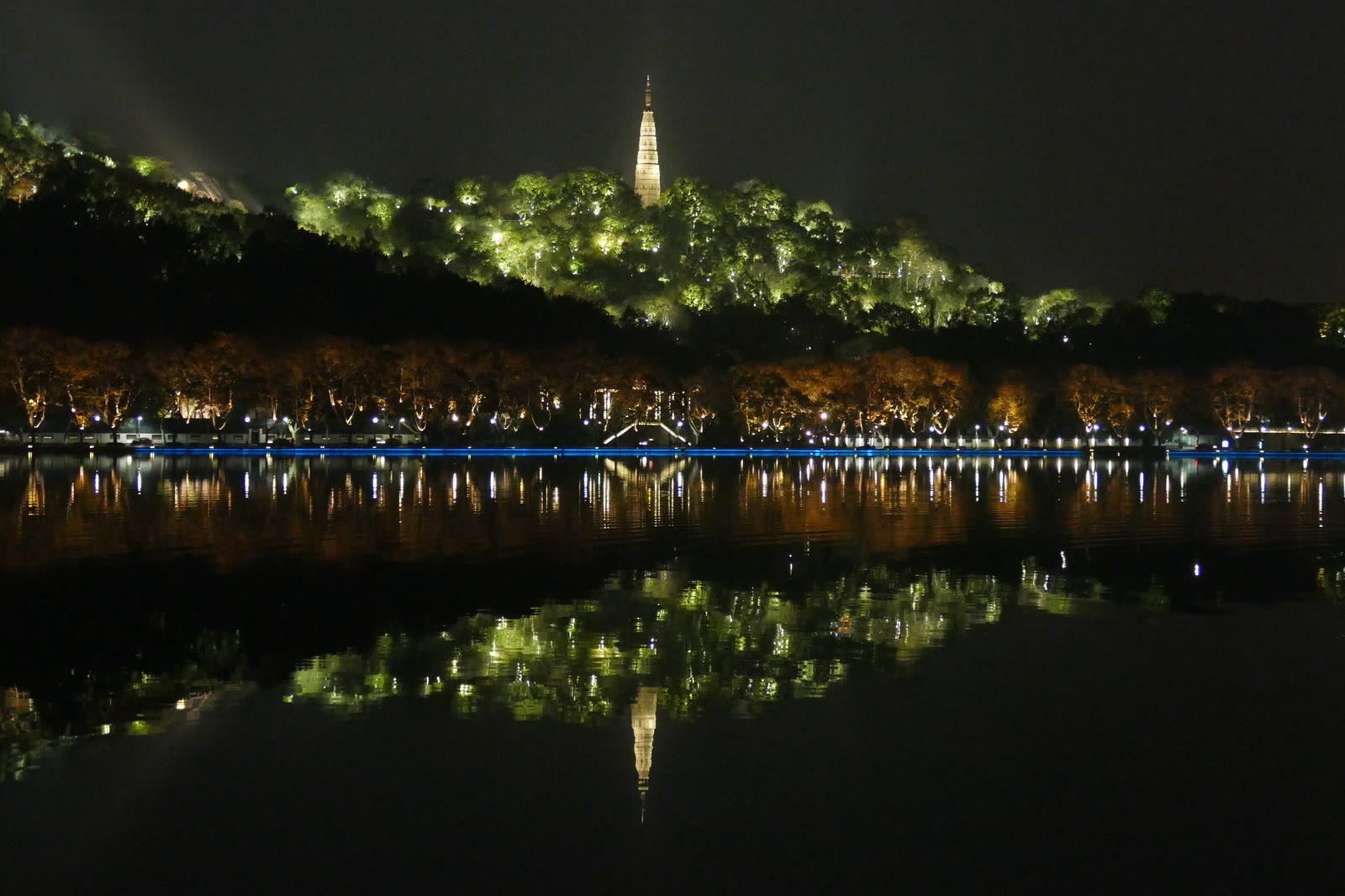
- Baoshi Hill & Baochu PagodaNorth Lake
If it rains Boats stop in storms and high wind. In heavy rain, skip the boat and Baoshi Hill (its stone steps get slippery) and spend the morning in the Zhejiang Provincial Museum next to Lou Wai Lou on Solitary Hill (free; passport registration in the '云上浙博' mini-program; closed Mondays), then walk the Bai Causeway under an umbrella — West Lake in mist is a classic view — and finish under cover in the Hubin in77 lanes.
Add if you have time Add Yue Fei Temple (¥25), a 10-minute walk west of Solitary Hill, before lunch; or stay up for the West Lake Musical Fountain (19:30 on the winter schedule — eat early if you want it).
Day 2Lingyin at opening, Dragon Well tea, the Su Causeway and Leifeng at sunset
- Ye Long Jing (Longjing Road) Bib Gourmand ’26Longjing
- Su CausewaySouth Lake
- Leifeng PagodaSouth Lake
- Fu Yuan Ju (Hefang Street) Bib Gourmand ’26Hefang & Wushan
- Hefang Street & QinghefangHefang & Wushan
If it rains Lingyin's halls and the cliff carvings work in rain, and Leifeng Pagoda is enclosed. Swap the tea village for the China National Tea Museum on Longjing Road (free; closed Tuesdays), skip the open Su Causeway, and take a taxi to Leifeng and Jingci Temple across the road; Hu Qing Yu Tang off Hefang Street is a covered stop before dinner.
Add if you have time Up early? Faxi Temple (¥10) opens at 06:30, 1.5 km up the road from Lingyin. Rather walk than sit? Skip the farmhouse tea and do the Nine Creeks walk down to Six Harmonies Pagoda instead of the Su Causeway. Or end with the Impression West Lake show (usually 19:40; book ahead) instead of Hefang Street.
Route last checked 2026-10-03 — verify hours and bookings before you go.
Add a third day: the Grand Canal and Xixi Wetland
Gongchen Bridge and the free canal museums by water bus, a Bib Gourmand lunch, then Xixi Wetland by boat — ending on Line 19, which runs straight to the airport.
The 2-day core plus a canal-and-wetland day that adds depth rather than more lake: the Grand Canal's last stone bridge and its free museums by water bus or Line 5, a Bib Gourmand Shaoxing lunch, then Xixi Wetland by boat. It ends in the north-west on Line 19, which runs straight to Hangzhou East and the airport.
Day 1West Lake — the island boat, Solitary Hill, the Bai Causeway and the lakefront at night
- Boat to Three Pools Mirroring the MoonOn the lake
- Solitary Hill (Gushan) & Xiling Seal SocietyNorth Lake
- Lou Wai Lou (Gushan Road)North Lake
- Broken Bridge & Bai CausewayNorth Lake
- Baoshi Hill & Baochu PagodaNorth Lake
If it rains Boats stop in storms and high wind. In heavy rain, skip the boat and Baoshi Hill and spend the morning in the Zhejiang Provincial Museum on Solitary Hill (free; passport registration in the '云上浙博' mini-program; closed Mondays), then walk the Bai Causeway under an umbrella and finish under cover in the Hubin in77 lanes.
Add if you have time Add Yue Fei Temple (¥25), a 10-minute walk west of Solitary Hill, before lunch; or catch the Musical Fountain (19:30 on the winter schedule).
Day 2Lingyin at opening, Dragon Well tea, the Su Causeway and Leifeng at sunset
- Ye Long Jing (Longjing Road) Bib Gourmand ’26Longjing
- Su CausewaySouth Lake
- Leifeng PagodaSouth Lake
- Fu Yuan Ju (Hefang Street) Bib Gourmand ’26Hefang & Wushan
- Hefang Street & QinghefangHefang & Wushan
If it rains Lingyin's halls and the cliff carvings work in rain, and Leifeng Pagoda is enclosed. Swap the tea village for the China National Tea Museum on Longjing Road (free; closed Tuesdays), skip the Su Causeway and take a taxi to Leifeng; Hu Qing Yu Tang off Hefang Street is a covered stop before dinner.
Add if you have time Faxi Temple (¥10, opens 06:30) before Lingyin; the Nine Creeks walk to Six Harmonies Pagoda instead of the Su Causeway; or the Impression West Lake show (usually 19:40; book ahead) instead of Hefang Street.
Day 3The Grand Canal at Gongchen Bridge, then Xixi Wetland by boat
- Gongchen Bridge & Qiaoxi Historic Block (Grand Canal)Grand Canal
- China Grand Canal MuseumGrand Canal
- Ge Lang Guan (Xiaohe Road) Bib Gourmand ’26Grand Canal
- Tong Ma Ma (Xihu) Bib Gourmand ’26Xixi
If it rains The Grand Canal Museum and the Arts & Crafts museums across the bridge are indoor and free, and the canal water bus is covered. Skip Xixi's open boats in heavy rain and spend the afternoon in Hu Qing Yu Tang and the Southern Song Imperial Street arcades near Hefang Street, or the Zhejiang Provincial Museum (closed Mondays).
Add if you have time Arrive at Gongchen Bridge the scenic way on the ¥3 Canal Water Bus Line 1 from Wulin Gate pier (about 20 minutes). Prefer a full water-town day? Swap this day for the Wuzhen day trip (high-speed train to Tongxiang, then bus; about 2 hours each way) — not on the day you fly.
Route last checked 2026-10-03 — verify hours and bookings before you go.
Want this as an interactive guide you can reshape by length, budget and pace — with the maps, food and a one-tap PDF?
Get the Hangzhou Destination Pass · S$9.90 Or build a free planWhere to stay in Hangzhou
Stay on the east shore of West Lake — Hubin (Longxiangqiao, Line 1) or around Wushan Square and Hefang Street (Line 7 straight to the airport) — so the lake, the old town and a metro line are all on foot. Hotels register your passport with the police at check-in (required within 24 hours); most mid-range and international hotels take foreign guests, but some small guesthouses and tea-village homestays still cannot, so check that the listing accepts foreign passports. Prices are per room per night and jump at weekends, during Golden Week (1–7 Oct), Chinese New Year and the spring tea and autumn osmanthus seasons.
Hubin (Longxiangqiao)
First-timers, walking to the lake, food
Wushan Square / Hefang Street
Old-town lanes, the airport on Line 7
Beishan Street / west shore
Lake-view splurges, couples
Wulin Square
Value business hotels, shopping
Hangzhou East Station
Early trains, one-night stopovers
By budget
- Budget — S$42–76 · Chain hotels (Hanting, Ji Hotel, Home Inn and similar), Hostels near Hefang Street (dorm beds from about ¥80)
- Mid-range — S$105–210 · 4-star and international mid-scale hotels, Boutique and design hotels
- Comfortable — S$285–860 · 5-star lakeside hotels, Garden resorts in the west hills
- Pick a hotel within 5–10 minutes' walk of Longxiangqiao or Ding'an Road (Line 1) or Wushan Square (Line 7) — the lake is then on foot and the airport one ride away.
- Check that the hotel accepts foreign passports before you pay; Trip.com listings usually say so. Tea-village homestays often cannot register foreigners.
- Save the hotel's name and address in Chinese for taxis and DiDi.
Prices and foreign-guest acceptance change. Confirm the current rate and that the property can register a foreign passport before you pay.
What to budget for Hangzhou
Per person, per day, excluding flights. A rough guide only — your costs depend on season, area and pace.
Budget
- Accommodation: Chain hotel (Hanting, Ji Hotel, Home Inn and similar) near Wushan Square or a Line 1 station (¥220–400 a room; hostel dorm beds from about ¥80).
- Meals: Pian'er chuan noodles at the MICHELIN-listed noodle shops, Zhi Wei Guan's snack hall, Hefang Street snacks and vegetarian noodles by Lingyin (¥15–60 a meal).
- Transport: Metro by Alipay or WeChat ride code (¥2–8 a ride), Bus 7 to Lingyin (¥2), walking on the causeways; a shared taxi to Lingyin or Longjing is only about ¥30.
- Attractions: Lingyin is free with a booking. The island boat (¥55, island entry included) and Leifeng Pagoda (¥40) are the two worth paying for; Yue Fei Temple (¥25) and Six Harmonies Pagoda (¥20) are cheap extras. For a free panorama, climb Baoshi Hill.
- Evening: The free Musical Fountain at Hubin, the lit Broken Bridge and Hefang Street's snack stalls.
Mid-range
- Accommodation: 4-star or boutique hotel in Hubin, around Wushan Square or at Wulin Square (¥550–1,100 a room).
- Meals: Hangzhou classics — Dongpo pork, Longjing shrimp, West Lake fish — at Lou Wai Lou or Hangzhou Restaurant, plus Bib Gourmand home cooking at Fu Yuan Ju or Ye Long Jing (¥60–250 a meal).
- Transport: Metro for the lake, Hangzhou East and the airport; DiDi or taxis for Lingyin, the tea villages and evenings.
- Attractions: The island boat, Leifeng Pagoda, a farmhouse glass of Longjing tea (about ¥30–60) and Xixi Wetland with the electric boat (¥80 + ¥60).
- Evening: A Hangzhou-cuisine dinner, the lit lake shore and Hefang Street; or the Impression West Lake show.
Comfortable
- Accommodation: 5-star lakeside hotel on Beishan Street or in Hubin, or a garden resort in the west hills (¥1,500–4,500 a room).
- Meals: MICHELIN-starred Zhejiang cooking — Jie Xiang Lou (two stars), Jin Sha or Longjing Manor (one star) — with lake-view lunches (¥300–1,500 a head).
- Transport: DiDi Premier or a hotel car between the lake, Lingyin and the tea hills; a private car and driver for Wuzhen.
- Attractions: Everything, plus a private hand-rowed boat on the lake, a private tea-farm visit and the VIP seats at the Impression West Lake show.
- Evening: A tasting menu, lake-view hotel bars, the Impression West Lake show.
When to visit Hangzhou
Weather, daylight, blossom dates and holiday crowds vary year to year. Treat this as general guidance and check a forecast, the daily AQI (english.mee.gov.cn, aqicn.org or IQAir) and official event calendars close to your dates.
Winter Dec, Jan, Feb
Cold and damp, roughly 1–10°C, with frosty mornings and occasional light snow; older buildings and farmhouse tea terraces are poorly heated.
Do the causeways and the boat around midday when it is warmest, and keep the Zhejiang Provincial Museum (closed Mondays), Hu Qing Yu Tang and Leifeng Pagoda's enclosed galleries for cold or wet spells. Boats stop in strong wind.
Look out for: 'Lingering snow on the Broken Bridge' — one of the Ten Scenes of West Lake, after a rare snowfall, Plum blossom at Solitary Hill (Gushan) and Lingfeng from late January into March, New Year prayers at Lingyin Temple (book early)
Spring Mar, Apr, May
Mild and changeable, roughly 9–26°C.
Spring is the best time for a farmhouse tea glass in Longjing or Meijiawu — but agree the price before you sit, and buy only tea weighed and priced in front of you. Carry an umbrella and keep the China National Tea Museum (closed Tuesdays) in reserve for showers.
Look out for: New-season West Lake Longjing tea (pre-Qingming 'Mingqian' leaves are the most prized), Peach and willow on the Su Causeway in late March, Tulips at Taiziwan and Huagang Park in March–April
Summer Jun, Jul, Aug
Hot and very humid — Hangzhou is one of the Yangtze delta's hottest cities, often 32–38°C in July and August.
Start at 07:30 with Lingyin or the causeways, spend midday in the Zhejiang Provincial Museum, the Grand Canal Museum or a teahouse, and return to the lake after 17:00. Thunderstorms cancel boats and the open-air show.
Look out for: Lotus in flower at Quyuan Fenghe and along the Bai Causeway (best in July), Longer West Lake Musical Fountain schedules on summer evenings, Shaded walks at Jiuxi and the Lingyin valley
Autumn Sep, Oct, Nov
The best season: roughly 12–28°C, drier and clearer, cooling to 8–18°C by late November.
Ideal walking weather — give the Su Causeway and the Nine Creeks walk more time. With sunset near 17:00 in November, be at Leifeng Pagoda or Baoshi Hill by about 16:00 for the light.
Look out for: Sweet osmanthus (guihua) in flower from late September into October, especially at Manjuelong by the Hupao road, Autumn colour at Jiuxi, the Beishan Street plane trees and the Su Causeway metasequoias in late November to early December, Hairy crab and new-season chestnuts on menus
Common Hangzhou mistakes to avoid
- Turning up at Lingyin Temple without a booking. Entry has been free since 1 Dec 2025 but needs a real-name slot in the '杭州灵隐飞来峰' mini-program (Alipay or WeChat), booked 1–7 days ahead — there is no same-day booking and no ticket window.
- Going to the China National Tea Museum on a Tuesday (both branches close on Tuesdays, not Mondays), or to the Zhejiang Provincial Museum or the Grand Canal Museum on a Monday.
- Buying 'Mingqian' Dragon Well tea from touts at the Longjing village bus stop or sitting down for tea without asking the price. Real top-grade West Lake Longjing costs thousands of yuan per 500 g — buy only where the tea is weighed and priced in front of you.
- Arriving without Alipay or WeChat Pay set up and tested — link your card, verify your passport and make a test payment in Singapore, and warn your bank. Hangzhou's metro takes the QR ride code, not foreign cards at the gates.
- Letting your Singapore SIM lapse: Alipay, WeChat, DiDi and your bank send one-time passwords to your +65 number.
- Relying on hotel Wi-Fi or a local SIM for Google, Instagram, WhatsApp or uploads — use roaming or an HK/SG-breakout eSIM.
- Assuming Changi Pay still works in China — its overseas QR payments ended on 1 Oct 2026. Use a card linked to Alipay/WeChat, DBS Remit to a Weixin Pay wallet, or OCBC's scan-and-pay.
- Pasting Google Maps coordinates into Amap or Baidu — China's maps use an offset datum, so pins land 100–700 m off (about 500 m around West Lake). Search by the Chinese name or address instead.
- Mixing up stations: Hangzhou East (high-speed hub), Hangzhou Railway Station (Chengzhan, central) and Hangzhou West (far west) are three different places; for Shanghai you almost always want Hangzhou East.
- Reaching Hangzhou East 15 minutes before departure — security queues are long and gates close a few minutes before the train (check the stop-boarding time in 12306).
- Doing West Lake at midday on a weekend or holiday. Walk the Broken Bridge and causeways early or after dark, and be at Lingyin for the 07:30 opening.
- Landing on the 22:50 SQ flight and expecting a train into town: the last Line 19 departure is 23:14 and Line 7 stops earlier — have DiDi or the taxi queue ready.
- Paying big hotel or mall bills through Alipay/WeChat with a foreign card (3% above ¥200) when the counter takes the card directly.
- Carrying only ¥100 notes — change can be short and counterfeit ¥100s circulate, even from ATMs.
- Accepting invitations to tea, a bar, a massage or an 'art student' gallery from friendly strangers in tourist areas.
- Staying in an Airbnb or private home without registering with the local police within 24 hours.
- Flying a drone over West Lake without CAAC real-name registration and activation (mandatory for new drones since 1 May 2026) — the scenic area is crowded and restricted.
- Miscounting the 30 visa-free days — they run from 00:00 the day after you arrive; keep a day in hand.
Good to know in Hangzhou
Getting around
- Metro: Line 1 for the lake shore (Longxiangqiao, Ding'an Road) and Hangzhou East; Line 7 for Wushan Square and the airport; Line 5 for the Grand Canal (Gongchen Bridge East); Line 3 for Xixi Wetland South; Line 19 for the airport, Hangzhou East and Xixi Wetland North. Most lines run from about 06:00 to 23:00.
- Around West Lake, walk: the Bai and Su causeways are car-free, and lakeside roads jam on weekends and holidays.
- No metro reaches Lingyin Temple or the tea villages. Take a taxi or DiDi (20–30 minutes from Hubin to Lingyin, about ¥30), Bus 7 to Lingyin (40–55 minutes, ¥2) or Bus 27 from Yuewang Road to Longjing village. Lingyin to Longjing village is about 15 minutes by taxi.
- On weekends and holidays (08:00–17:00) taxis to Lingyin stop at outer car parks; a ¥2 shuttle runs to the gate.
- The ¥3 Canal Water Bus Line 1 runs from Wulin Gate pier to Xinyifang, Gongchen Bridge and Canal Tiandi (about 20 minutes to Gongchen Bridge; weekday sailings roughly 07:00–18:54).
- Navigate with Amap (English interface) or Apple Maps and search places by their Chinese name or address — Google Maps is blocked on Chinese networks and its China map is offset by about 500 m here.
- Taxis start at ¥13 for 3 km (¥2.50 a km to 10 km, then ¥3.75); per-km rates rise 30% from 23:00 to 05:00. DiDi prices are similar.
- Train tickets are real-name: book on Railway 12306 (12306.cn/en; foreign cards accepted, no booking fee) or Trip.com with your passport, up to 15 days ahead (the travel day counts). Show the same passport at the station entrance, the platform gate and the exit; arrive 45–60 minutes early at Hangzhou East, and check the stop-boarding time — gates close a few minutes before departure.
Open Alipay → Transport (出行) → ride code and choose Hangzhou, or use the ride-code mini-program in WeChat; scan in and out at the QR readers on every gate. The same Alipay code works on city buses. T…
Money & connectivity
- China runs on Alipay and WeChat Pay, and Hangzhou — Alipay's home city — more than most: tea farms, noodle shops, boat piers and the metro all take QR payment. Before you fly, register both with your +65 number, link a Singapore Visa/Mastercard/Amex/JCB, complete passport verification and make a small test payment; tell your bank you are travelling (first foreign transactions are often blocked as fraud). Fees: Alipay charges nothing up to ¥200 and 3% of the whole amount above it; WeChat Pay charges nothing under ¥200 and 3% above (new international-card users get 60 days fee-free under ¥1,000, capped at ¥30 saved per transaction), plus your card's own FX fee of about 3–3.5%. Singapore options: DBS Remit can fund your own Weixin Pay balance fee-free, and the OCBC app scans Weixin Pay, Alipay+ and UnionPay QR codes (no extra OCBC fee). Changi Pay stopped overseas Alipay/Alipay+ QR payments on 1 Oct 2026. Cards work at star-rated hotels, A-level attractions, big malls, international chains, 12306, Trip.com and DiDi — pay large hotel and mall bills by card to avoid the 3% wallet fee. Since 1 Feb 2026 shops that serve customers face to face must accept RMB cash; carry ¥500–1,000 in ¥10/¥20/¥50 notes as backup. Bank of China ATMs (English menus) are the most reliable — expect a local fee of about ¥20–30 and a cap of about ¥2,500–3,000 per withdrawal, plus your own bank's charges. Limits for visitors: US$5,000 per transaction, US$50,000 a year.
- Google (Search, Gmail, Maps, YouTube), WhatsApp, Telegram, Instagram, Facebook, X, ChatGPT and most Western news sites are blocked on Chinese networks — local SIMs, hotel and café Wi-Fi. Easiest: roam on your Singapore plan (data routes home, so blocked apps work) or buy a travel eSIM with Hong Kong/Singapore breakout ('no VPN needed'). A local China Mobile/Unicom/Telecom SIM bought at the airport with your passport (about ¥100–200 for 30 days, per third-party guides) is cheap but filtered; tourists can't get domestic eSIMs. Don't count on a VPN — only licensed ones are legal and consumer VPNs are unreliable. Keep your Singapore SIM active for SMS one-time passwords (dual SIM: eSIM for data, SG SIM for SMS). Install before you fly: Alipay, WeChat, Amap, DiDi, Railway 12306 and Trip.com, NIA 12367, an offline translator, and RedNote/Dianping for local tips. Apple Maps works without a VPN.
- Tipping is not customary — restaurants, taxis, boat crews and hotels don't expect it, and upscale hotel restaurants may already add a 10–15% service charge (don't add more). Exceptions: private guides about ¥100–200 a day per group, private drivers ¥50–100 a day, porters ¥10–20 (optional). Give tips in cash, with both hands.
Local etiquette
- Your passport is your ID for everything — hotel check-in, trains, the Lingyin booking, museums, SIM cards. Carry the physical passport (16 and over must carry it at all times); photos and copies are not accepted at gates.
- Mandarin works everywhere in Hangzhou and the script is Simplified Chinese, the same as Singapore. Older locals chat in the Hangzhou dialect among themselves.
- Tea is the city's pride: West Lake Longjing (Dragon Well) is served as loose green leaves in a tall glass, topped up with hot water — don't drink the leaves, and let the host refill. Farmhouses sell tea by the jin (500 g); ask the price per jin before anything is weighed.
- Temples (Lingyin, Faxi, Jingci) are active places of worship: dress modestly, walk round the kneeling cushions, keep voices low and follow the no-photo signs inside halls.
Police: 110 · Ambulance: 120 · Fire: 119 · Traffic accidents: 122 · China Immigration Service hotline (visas, arrival card, stays): 12367 · Hangzhou city hotline: 12345 · Consulate-General of Singapore in Shanghai: 89 Wanshan Road, Shanghai (上海市万山路89号), +86-21-6278 5566 — its consular district covers Zhejiang, including Hangzhou. · MFA 24-hour Consular Response Centre: +65 6379 8800 (mfa_duty_officer@mfa.gov.sg). eRegister your trip at eregister.mfa.gov.sg before you go. · Lost passport: report it to the local police, then to ICA online with Singpass; get a new passport or Document of Identity from the Consulate-General in Shanghai with the police report, a photo and proof of citizenship; then apply for a Chinese Exit Permit at the Exit-Entry bureau (normally about 5 working days). · Tap water is not safe to drink — use bottled or boiled water. · Keep your hotel name and address in Chinese on your phone and on paper for taxis and emergencies.
Hangzhou — frequently asked questions
Is 2 days enough for Hangzhou?
2 days is the usual recommendation for Hangzhou. The plan here runs to 2 days, and the full guide builds routes from 1–3 days — so you can shorten or extend it to fit your trip.
What food is Hangzhou known for?
Hangzhou's highlights include Zhi Wei Guan (Renhe Road), Lou Wai Lou (Gushan Road), Hangzhou Restaurant (Yan'an Road), Kui Yuan Guan (Jiefang Road), Wu Zi Mian Guan and more. Each is linked to Google Maps in the route above; famous spots queue at peak times, so go off-peak or pick a neighbouring stall.
Where should I stay in Hangzhou?
Good bases include Hubin (Longxiangqiao) (First-timers, walking to the lake, food); Wushan Square / Hefang Street (Old-town lanes, the airport on Line 7); Beishan Street / west shore (Lake-view splurges, couples). See "Where to stay" above for the full breakdown by budget.
How much does Hangzhou cost per day?
Roughly around S$55–100 a day on a budget, S$125–240 mid-range, S$300–750 comfortable per person, excluding flights and accommodation swings. See "Budget" above for what each tier covers.
When is the best time to visit Hangzhou?
Weather, daylight, blossom dates and holiday crowds vary year to year. Treat this as general guidance and check a forecast, the daily AQI (english.mee.gov.cn, aqicn.org or IQAir) and official event calendars close to your dates. See "When to go" above for the month-by-month detail.
Do I need to book Lingyin Temple?
Yes. Entry to the Lingyin and Feilai Feng scenic area has been free since 1 December 2025, but every visitor needs a free real-name booking: search '杭州灵隐飞来峰' in Alipay or WeChat, switch the ID type to Passport and book 1–7 days ahead — slots release at 08:00 each day for the day a week out, and there is no same-day booking or ticket window. Choose the morning session (07:30–12:00) and be at the gate by 08:00 with the same physical passport; foreign passports usually go through the staffed lane. Cancel by 17:00 the day before if your plans change — since February 2026 a no-show bars you from booking for 30 days, and longer for repeat no-shows.
How do I get from Shanghai to Hangzhou?
By G train from Shanghai Hongqiao to Hangzhou East: trains leave every few minutes, the fastest take about 45 minutes and second class costs roughly ¥60–90. Tickets are real-name — book on Railway 12306 or Trip.com with your passport (sales open 15 days ahead) and show the same passport at the entrance, the platform gate and the exit. From Hangzhou East, Metro Line 1 reaches Longxiangqiao by the lake in about 25–30 minutes. Coming straight from Pudong Airport, take the Airport Link Line to Hongqiao first and allow about 3 hours door to door.
How do I pay in Hangzhou as a Singaporean?
Mostly by Alipay or WeChat Pay with your Singapore card linked — Hangzhou is Alipay's home city, and tea farms, noodle shops, boat piers and the metro all take QR codes. Set both up, verify your passport and make a test payment before you fly, and tell your bank you're travelling. Both wallets are free up to ¥200 and charge 3% above that on foreign cards (plus your card's FX fee), so pay big hotel bills by card directly. The metro does not take foreign Visa or Mastercard taps at the gates (as of August 2026) — use the Alipay or WeChat ride code. Changi Pay's overseas QR payments ended on 1 Oct 2026; shops must accept RMB cash, so carry ¥500–1,000 in small notes as backup.
Do I need a visa for China?
Singapore ordinary passports enter mainland China visa-free for up to 30 days per entry under the China–Singapore mutual visa exemption (in force since 9 Feb 2024; still listed by China's MFA in May 2026 and confirmed by ICA and MFA Singapore). The 30 days count from 00:00 on the day after you arrive — arrive 1 Nov, leave by 23:59 on 1 Dec — so keep a day in hand. It covers tourism, visiting family, business meetings and other private trips only; work, news reporting and commissioned or paid filming need a visa, and repeat visitors should treat 90 days in any 180 as a cap. Carry a passport valid for the whole stay (6 months is the safe norm because airlines may check), plus your return ticket and first hotel booking. Fill in the arrival card online before you fly (NIA website s.nia.gov.cn/ArrivalCardFillingPC/, the 'NIA 12367' app or the WeChat/Alipay mini-program) or use the kiosks in the immigration hall. At customs, declare cash over ¥20,000 or foreign currency worth more than US$5,000; fresh fruit, vegetables and meat are restricted, and drones must be registered and activated before flying. Hotels register you with the police at check-in; in an Airbnb or private home you or your host must register within 24 hours. Arriving overland from Shanghai there are no further checks. Other passports follow different rules — check your own requirements, and re-confirm on ICA and MFA Singapore before you travel.
Plan Hangzhou your way
Start free, or get the complete interactive guide — maps, food, day-by-day routes you can reshape, and a one-tap PDF.