
Chongqing in 3 Days: A Practical Itinerary
The train through a building, Hongyadong lit at night, the Yangtze cable car, Ciqikou, the Three Gorges Museum and a hotpot every night — a practical three-day Chongqing plan with Maps links, Chinese names for taxis, budgets and what to set up before you fly.
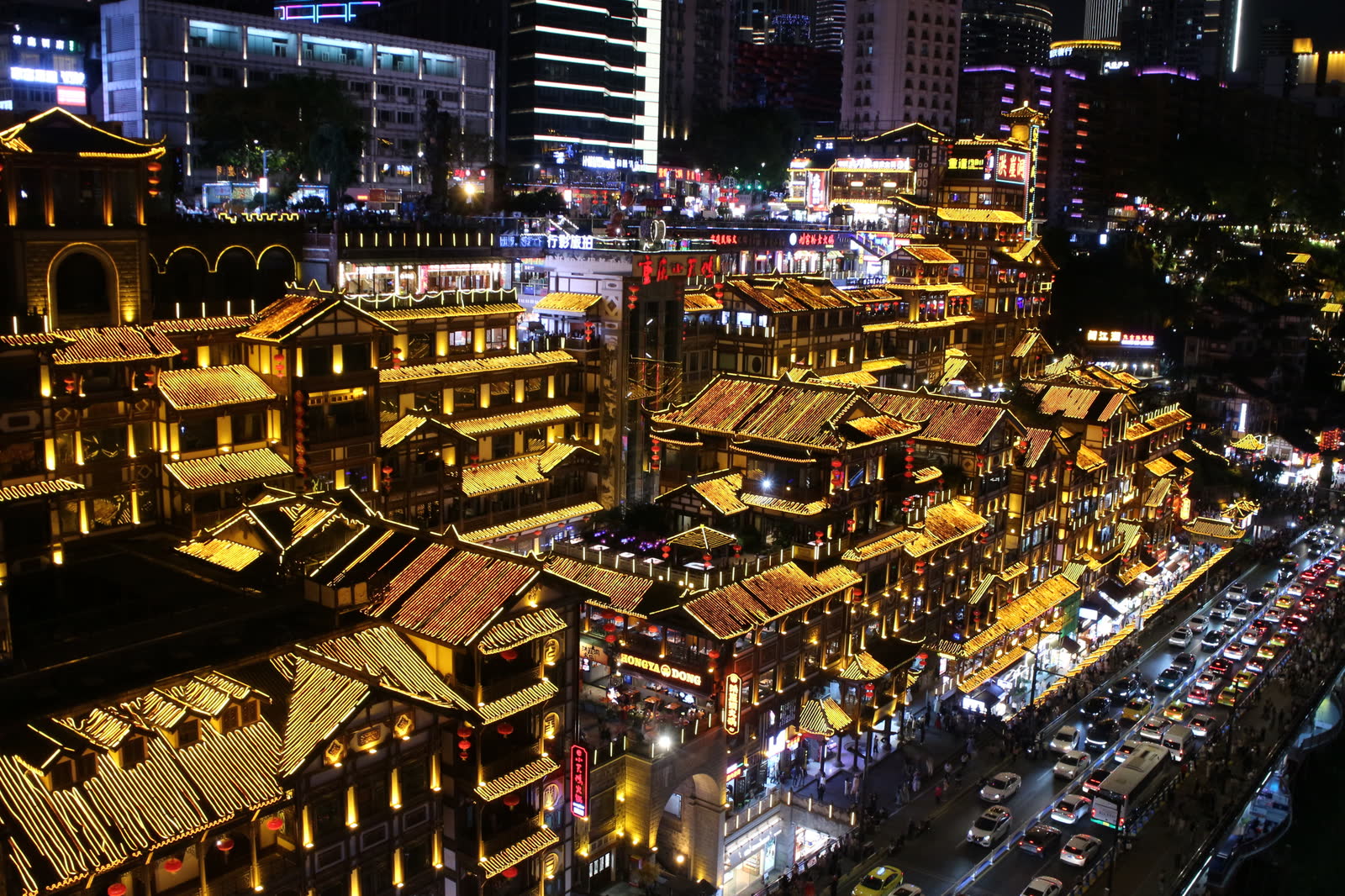
Chongqing is China's '8D city' — a mountain metropolis piled onto cliffs where the Yangtze meets the Jialing, so a building's ground floor can sit beside another's 22nd and a monorail runs straight through a block of flats. It is cheap, intense and best after dark, when Hongyadong's cliff houses and the skyline light up. Three days covers the essentials at a sensible pace; two is enough for the highlights.
This plan walks the stairways, Shibati and the cable car on day one and ends at Hongyadong; sweeps from Ciqikou through Liziba and Eling to the Nanshan night view on day two; and keeps day three on the airport's metro line with the free Three Gorges Museum, People's Square and the river confluence. Set up Alipay or WeChat Pay and a roaming or HK-breakout eSIM before you fly, carry your passport (it's your ticket for the museum, cableway and trains), and use the Chinese names in each stop with Amap or a taxi driver.
At a glance
Your day-by-day Chongqing route
A 3-day Chongqing route
Day one is walkable and booking-free for arrival; day two runs west to east and ends on Nanshan; day three sits on Line 10 for the airport. The Three Gorges Museum is closed on Mondays.
Day 1: the walkable east of the peninsula and Hongyadong at night (arrival-friendly, no bookings). Day 2 sweeps west to east — Ciqikou on Line 1 early, Liziba and Eling, the south bank at Longmenhao, then dinner and the night view on Nanshan. Day 3 stays near Line 10 for departure: the Three Gorges Museum (closed Mondays) and Great Hall, then Huguang Guild Hall, Chaotianmen and Raffles City.
Day 1Stairs, the Yangtze cable car and Hongyadong lights
- Shancheng Alley & the Mountain City TrailJiefangbei
- Shibati (Eighteen Steps) old quarterJiefangbei
- Shibati Douhua Restaurant (douhua rice)Shibati old quarter, Yuzhong
- Jiefangbei (Liberation Monument) & pedestrian squareJiefangbei
- Yangtze River CablewayJiefangbei
- Pei Jie Old Hotpot (Hongyadong branch)Cangbai Road, next to Hongyadong, Yuzhong
- Hongyadong at nightJiefangbei
- Qiansimen Bridge walk to Jiangbeizui (the Hongyadong view)Jiefangbei
If it rains Swap Shancheng Alley's cliff walk for Luohan Temple and Jiefangbei's underground malls; Shibati's lanes are partly covered. The cableway may pause in storms — cross on Line 6 instead. Hongyadong glows in drizzle; skip the bridge walk in heavy rain.
Add if you have time Add Kuixing Building (the 22nd-floor 'ground floor') between Jiefangbei and Hongyadong, or the Two Rivers night cruise from Hongyadong pier after the lights.
Day 2West to east — Ciqikou, Liziba and Eling, then Nanshan by night
- Ciqikou Ancient TownCiqikou
- Liziba Station — the train through a buildingLiziba / Eling
- TestBed 2 cafés & restaurantsTestBed 2, Eling, Yuzhong
- Eling Park & Kansheng Tower lookoutLiziba / Eling
- Longmenhao Old Street & XiahaoliNan'an riverside
- Nanshan spring-water chickenThe road over Nanshan between Huangjueya and the One Tree viewpoint, Nan'an
If it rains Ciqikou's lanes are partly covered but slippery — go anyway early. Swap Eling Park for the Three Gorges Museum (free; closed Mondays) and, if fog or rain hides the skyline, swap Nanshan for the Raffles City Exploration Deck or simply dinner at Longmenhao with the view.
Add if you have time If it's a Saturday, swap Nanshan for the 20:30 drone show from the Changjiahui terraces (Loop Line Danzishi) and eat at Changjiahui.
Day 3The Three Gorges, People's Square and the river confluence
- Chongqing China Three Gorges MuseumPeople's Square
- Great Hall of the People (Chongqing People's Auditorium)People's Square
- Meizhuanxiao Street local eateries (near People's Square)Meizhuanxiao Street, a 5-min walk west of the Three Gorges Museum, Yuzhong
- Huguang Guild HallChaotianmen
- Chaotianmen Square — where two rivers meetChaotianmen
- Raffles City Chongqing dining floorsRaffles City, 8 Jiesheng Street, Chaotianmen, Yuzhong
- Raffles City 'The Crystal' Exploration DeckChaotianmen
If it rains Already mostly indoor — the museum, the Great Hall, Huguang's halls and Raffles City. Skip Chaotianmen Square in heavy rain and skip the Exploration Deck if cloud hides the view.
Add if you have time Take the Two Rivers night cruise from Chaotianmen pier instead of the deck, or ride the Huangguan Escalator after the Great Hall.
Route last checked 2026-10-03 — verify hours and bookings before you go.
Want this as an interactive guide you can reshape by length, budget and pace — with the maps, food and a one-tap PDF?
Get the Chongqing Destination Pass · S$9.90 Or build a free planWhere to stay in Chongqing
Stay on the Yuzhong peninsula (Jiefangbei, Hongyadong, Chaotianmen) for a first trip — Hongyadong, Shibati, the cableway, the night cruises and three metro lines are all walkable. In the 8D city, check how your hotel is reached: some lobbies sit on a high floor of a tower, and a '300 m walk' can mean 200 steps — pick one within a few minutes of a metro station or with a lift link from the street. Hotels register your passport with the police at check-in. Most hotels now accept foreign guests, but some small guesthouses and serviced flats still cannot register a foreign passport — confirm 'accepts foreign guests' when booking (Trip.com shows it). Prices are estimates and jump during National Day Golden Week (1–7 Oct) and Spring Festival.
Jiefangbei / Hongyadong (Yuzhong)
First-timers, food streets, night views
Chaotianmen / Raffles City
River views, big hotels, night cruises
Nanbin Road (Nan'an)
Skyline-facing rooms, quieter evenings
Guanyinqiao (Jiangbei)
Shopping, airport and Chongqing North access
Lianglukou / People's Square
Museum day, Line 10 to the airport
By budget
- Budget — S$30–60 · Hostels with private rooms, Budget chain hotels (Hanting, Home Inn, Ibis)
- Mid-range — S$65–135 · 4-star and upscale chain hotels (Atour, Mercure, Holiday Inn), Boutique hotels with river views
- Comfortable — S$170–420 · 5-star international hotels, High-floor river-view suites
- Book early for National Day Golden Week (1–7 Oct), Spring Festival and summer weekends — prices can double.
- Ask for a high floor facing the river (江景房) if you want the night skyline from your room.
- Check the exact entrance and lobby floor on Amap before arriving with luggage — taxis may drop you on a different level.
Prices and availability change constantly. Confirm current rates, the exact address in Chinese and that the property accepts foreign passports before paying.
What to budget for Chongqing
Per person, per day, excluding flights. A rough guide only — your costs depend on season, area and pace.
Budget
- Accommodation: Hostel private room or budget chain hotel near a metro station (¥150–300/night).
- Meals: Xiaomian breakfasts (¥10–18), douhua rice and snack-street lunches (¥15–30), a neighbourhood hotpot dinner (¥80–100 a head).
- Transport: Metro on the Alipay/WeChat ride code (¥2–7 a ride); walk the peninsula; one-way cableway (¥30).
- Attractions: Mostly free sights — Liziba, Hongyadong, Shibati, Ciqikou, Eling and the Three Gorges Museum cost nothing. Add the cableway and the ¥30 Nanshan viewpoint.
- Evening: Hongyadong lights from Qiansimen Bridge, Bayi Road snacks, Chaotianmen at night.
Mid-range
- Accommodation: 4-star or upscale chain hotel in Jiefangbei, Hongyadong or Chaotianmen, ideally with a river view (¥350–700/night).
- Meals: A famous hotpot (Pei Jie and the like, ¥120–180 a head), jianghu-cuisine restaurants and snack streets (¥40–150/meal).
- Transport: Metro plus DiDi for uphill hops and the Nanshan night view (most rides ¥15–40).
- Attractions: Cableway return, the Raffles City Exploration Deck or the Two Rivers night cruise, the Great Hall and Huguang Guild Hall.
- Evening: One night cruise, one Nanshan night view, Hongyadong.
Comfortable
- Accommodation: 5-star international hotel in Jiefangbei, Raffles City or on Nanbin Road, high-floor river view (¥900–2,200/night).
- Meals: Top hotpot and jianghu-cuisine restaurants with a view, hotel dining and a riverside terrace dinner (¥150–400/meal).
- Transport: DiDi Premier or taxis door to door; a private car and driver for the Wulong or Dazu day trip (book through your hotel or Trip.com).
- Attractions: Every deck and cruise, the Huguang Guild Hall's Sichuan-opera show, guided Dazu or Wulong.
- Evening: Premium cruise boat from Chaotianmen, the Exploration Deck at sunset, a hotel sky bar.
When to visit Chongqing
Chongqing is hot and humid in summer, mild and misty in winter, and often overcast all year — river fog is common from late autumn to early spring and can hide the night views. Treat this as general guidance; check a forecast and the daily AQI (english.mee.gov.cn, aqicn.org or IQAir) close to your dates, and plan Nanshan and the Raffles deck for clear evenings.
Winter Dec, Jan, Feb
Cool, damp and grey, roughly 6–12°C; snow is very rare in the city.
Plan museums, malls and hotpot for foggy days; keep night-view stops flexible and go up Nanshan only if the peninsula is visible. Wulong can be cold and icy in the hills — check the forecast.
Look out for: Hotpot season — the city's favourite time to eat it, Spring Festival lights and temple fairs, Chongqing Marathon (10 Jan 2027)
Spring Mar, Apr, May
Mild to warm, roughly 14–26°C; one of the best times to walk the stairs.
Do Ciqikou and the cableway on weekday mornings; book Wulong and Dazu tickets and trains early for holiday weeks.
Look out for: Blossom in Eling and Nanshan parks, Labour Day Golden Week crowds
Summer Jun, Jul, Aug
Hot and humid — one of China's 'furnace' cities, often 33–38°C in July and August and occasionally above 40°C.
Start at 07:30–08:00, retreat to the Three Gorges Museum, Raffles City or the malls from 11:00 to 16:00, then go out again for the evening lights. Drink plenty and use taxis for uphill hops.
Look out for: Night-time city life and riverside BBQ, Cooler escapes in Wulong's Xiannüshan
Autumn Sep, Oct, Nov
Warm in September (about 25–30°C), comfortable in October (about 18–24°C), cooler and misty by November (about 12–18°C).
Avoid 1–7 October if you can. On drizzly days swap Eling and Nanshan for the museum and Raffles City; Hongyadong still glows in light rain.
Look out for: Golden Week crowds and the National Day flag-raising at the Great Hall, Saturday drone shows over the confluence (e.g. 17, 24, 31 Oct 2026), Wulong off-season prices from November
Common Chongqing mistakes to avoid
- Arriving without Alipay or WeChat Pay set up and tested. Link your card, verify your passport, make a test payment in Singapore and warn your bank — first foreign transactions are often blocked as fraud.
- Letting your Singapore SIM lapse or switching it off. Alipay, WeChat, DiDi and your bank send one-time passwords to your +65 number. Use dual SIM: eSIM for data, Singapore SIM for SMS.
- Relying on hotel Wi-Fi or a local SIM for Google, Instagram, WhatsApp or YouTube uploads. These are filtered; use roaming or a travel eSIM with HK/SG breakout. Don't count on a VPN.
- Assuming Changi Pay still works in China. Its overseas QR payments ended on 1 Oct 2026. Use a card linked to Alipay or WeChat, DBS Remit to a Weixin Pay wallet, or OCBC Scan & Pay.
- Trusting the map dot in the 8D city. Your destination may be 20 floors above or below you — follow Amap's walking route (it shows lifts and exits) and allow 10–15 extra minutes per hop.
- Pasting Google Maps coordinates into Amap or Baidu without converting them. China's maps use an offset datum, so the pin lands 100–700 m off. Search by the Chinese name instead (every stop in this guide has one).
- Going to Hongyadong in daylight or on a holiday evening. The lights come on around dusk (19:30–23:00 since 3 Sep 2026); on public holidays the area runs traffic control and may switch to free time-slot reservations.
- Turning up at the Yangtze River Cableway at 7 pm on a weekend. Queues can run an hour or more — go early in the morning or on a weekday, or book on the official 长江索道 WeChat account and take a queue number.
- Planning the Three Gorges Museum for a Monday. It is closed on Mondays except public holidays. Entry has been free and reservation-free since 1 Oct 2025 — just bring your passport.
- Booking with a name or passport number that doesn't exactly match the passport you carry — train, cableway, museum and day-trip tickets are all real-name.
- Arriving at Chongqing North, West or East 15 minutes before a high-speed train. Security queues are long, gates close 2–7 minutes before departure, and the three stations are far apart — check which one is on your ticket.
- Treating Wulong as a quick half-day. It is a full day: ~45 min to Chongqing East, 35–50 min by train, ~45 min to the Three Natural Bridges, about 3 hours on the trail, then the same back.
- Ordering hotpot 'mild' and expecting mild. Ask for 不辣 or a split pot, and keep a cold drink handy.
- Paying large bills through Alipay or WeChat with a foreign card (3% fee above ¥200) when the hotel or mall takes the card directly.
- Carrying only ¥100 notes. Change can be short, and counterfeit ¥100 notes circulate.
- Accepting invitations to tea, a bar, a massage or an 'art gallery' from friendly strangers in tourist areas.
- Staying in an Airbnb or private home without registering with the local police within 24 hours (hotels do it for you at check-in).
- Miscounting the 30 visa-free days. Days run from the day after arrival; keep a buffer, and repeat visitors should watch the 90-days-in-180 cap.
- Bringing a power bank without a clear 3C (CCC) mark, or from a recalled batch, onto a domestic Chinese flight, or using one to charge devices in flight.
- Flying a drone without CAAC real-name registration and activation (required for new drones since 1 May 2026).
Good to know in Chongqing
Getting around
- Metro and monorail cover everything in this guide: Line 2 (the monorail) for Linjiangmen, Liziba, Fotuguan (Eling Park) and the Zoo; Line 1 for Ciqikou, Eling, Lianglukou, Jiaochangkou, Xiaoshizi and Chaotianmen; Line 10 for the Great Hall, Chongqing North and the airport; Line 6 for Xiaoshizi, Grand Theatre (Jiangbeizui), Shangxinjie (Nan'an) and Chongqing East; the Loop Line for Danzishi, Shangxinjie, Chongqing North (South Square) and Chongqing West; Line 18 for Huangjueping.
- Navigate with Amap (高德地图) in English — in the 8D city it shows which station exit, lift or footbridge to use. Search by the Chinese name in this guide.
- Expect stairs on almost every walk. Use public lifts, escalators (the Huangguan Escalator) and the Yangtze cableway the way locals do.
- DiDi and metered taxis are cheap — use them for Nanshan at night, or when a 'short walk' crosses 20 storeys.
- Avoid 07:30–09:00 and 17:30–19:00 on Lines 2 and 3 with luggage; crowds are intense.
- The Yangtze River Cableway (¥30 one-way, ¥50 return) is both a sight and a river crossing to Longmenhao and Nan'an.
Easiest: open Alipay (Transport/出行) or WeChat, find the Chongqing ride code (乘车码) and scan it at the gate on entry and exit — foreign-card-linked accounts work in major cities; the 渝畅行 app does the s…
Money & connectivity
- Alipay and WeChat Pay (Weixin Pay) with a Singapore Visa, Mastercard, Amex, JCB, Diners or Discover card linked are how Chongqing pays — street stalls, noodle shops, taxis and vending machines take QR codes or cash only. Set up in Singapore: register both with your +65 number, link your card, complete passport verification and make a small test payment; a new WeChat account may need an existing user to verify it, so start early, and warn your bank (first foreign transactions are often blocked). Fees: WeChat Pay charges nothing on single payments under ¥200 and 3% above (new international-card users get 60 days fee-free under ¥1,000, capped at ¥30 saved per payment); Alipay is free at ¥200 or less and 3% of the whole amount above ¥200 (¥250 costs ¥7.50); your card's foreign-currency fee (about 3–3.5% on Singapore cards) comes on top. Limits for visitors: US$5,000 per transaction, US$50,000 a year. Singapore options: DBS Remit can fund your own Weixin Pay wallet balance with no fees (since 5 Jun 2026), which avoids the 3% card charge; since 9 Feb 2026 the OCBC app can scan Weixin Pay, Alipay+ and UnionPay merchant QR codes in China with no additional OCBC fees. Changi Pay stopped overseas Alipay/Alipay+ QR payments on 1 Oct 2026. Tencent's TenPayGo (launched 24 Sep 2026) is brand new — a backup only. Alipay TourCard is gone; link your card directly. Cards work at star-rated hotels, big malls, A-level attractions, the metro ticket windows, 12306, Trip.com and DiDi — pay large hotel or mall bills by card to avoid the 3% wallet fee. Cash: carry ¥500–1,000 in ¥10/¥20/¥50 notes plus a few ¥100s; since 1 Feb 2026 face-to-face businesses must accept RMB cash and keep change, but change can still be short. Bank of China ATMs are the most reliable (English menus, about ¥20–30 local fee, ~¥2,500–3,000 per withdrawal); use machines inside branches. Counterfeit ¥100 notes circulate, even from ATMs.
- Chinese networks (local SIM, hotel and café Wi-Fi) block Google (Search, Gmail, Maps, YouTube), WhatsApp, Telegram, Signal, Facebook, Instagram, Threads, X, many Western news sites, ChatGPT, Claude and Gemini; international TikTok doesn't work (the local version is Douyin). Options: (1) Singapore roaming (Singtel, StarHub, M1) — data routes home, so blocked apps work and SMS one-time passwords keep arriving; simplest but dearer. (2) A travel eSIM with Hong Kong or Singapore breakout (look for 'HK/SG breakout' or 'no VPN needed'). (3) A China Mobile, Unicom or Telecom SIM bought with your physical passport at an airport counter (about ¥100–200 for 30 days per third-party guides) — fast and cheap but fully filtered; carrier eSIMs need a Chinese ID. Only government-licensed VPNs are legal and consumer VPNs are unreliable, so don't depend on one. Use dual SIM: eSIM for data, Singapore SIM for SMS. Install before you fly: Alipay, WeChat, Amap (English since Jan 2025; 'Amap Global'), DiDi, Railway 12306 and Trip.com, NIA 12367, a translator with offline packs, RedNote/Xiaohongshu and Dianping, and your bank's app with overseas use switched on. Apple Maps works without a VPN. Content creators: hotel Wi-Fi won't upload to Instagram, TikTok or YouTube — budget roaming or eSIM data.
- Tipping is not customary in mainland China — restaurants, taxis and hotels don't expect it, and staff may be confused if you try. Upscale hotel restaurants may add a 10–15% service charge; don't add more. Exceptions: private tour guides about ¥100–200 a day per group, private drivers about ¥50–100 a day per group, porters ¥10–20 (optional). Give tips in cash, with both hands.
Local etiquette
- Your passport is your ID for everything — hotels, trains, museums, the cableway, SIM cards and some lockers. Carry the physical passport, not a photo; anyone over 16 must carry it at all times.
- Mandarin is spoken everywhere and the script is Simplified Chinese, the same as Singapore, so Mandarin-speaking Singaporeans have a big advantage. Locals speak Chongqing (Sichuanese) dialect among themselves.
- Spice: in Chongqing 微辣 ('mild') is still hot for most visitors. Ask for 不辣 (not spicy) or a 鸳鸯锅 (split pot with a plain broth) at hotpot. Hotpot is shared; locals dip in sesame oil with garlic (油碟).
- Ordering by QR code is standard: scan the table code to order and pay. Ask for a paper menu (纸质菜单) if your apps fail.
Police: 110 · Ambulance: 120 · Fire: 119 · Traffic accidents: 122 · Directory: 114 · China Immigration Service hotline (visas, arrival card, stays): 12367 · City government hotline: 12345 · Singapore Consulate-General in Chengdu (covers Chongqing, Sichuan and Shaanxi): Level 30-01 Yanlord Landmark Office Tower, 1 Section 2 Renmin South Road, Chengdu · +86-28-8652 7222 · Singapore Embassy in Beijing: +86-10-6532 1115 · MFA 24-hour Consular Response Centre: +65 6379 8800 (mfa_duty_officer@mfa.gov.sg) · Lost passport: report to the local police or Exit-Entry bureau; report to ICA online with Singpass (you can apply for a new passport one working day later) or go to the Consulate-General in Chengdu with the police report, a photo and proof of citizenship; then get a Chinese Exit Permit from the Exit-Entry bureau (normally about 5 working days). · eRegister your trip at eregister.mfa.gov.sg before you fly. · Tap water is not safe to drink — drink bottled or boiled water. · Keep your hotel address in Chinese characters for taxis and DiDi.
Chongqing — frequently asked questions
How many days do you need in Chongqing?
2–3 days is the usual recommendation for Chongqing. The plan here runs to 3 days, and the full guide builds routes from 1–4 days — so you can shorten or extend it to fit your trip.
What food is Chongqing known for?
Chongqing's highlights include Pei Jie Old Hotpot (Hongyadong branch), Bayi Road snack street (Haochi Jie), Xiaofeng Noodle Shop (Chongqing xiaomian), Super Li Bench Noodles (flagship), Shibati Douhua Restaurant (douhua rice) and more. Each is linked to Google Maps in the route above; famous spots queue at peak times, so go off-peak or pick a neighbouring stall.
Where should I stay in Chongqing?
Good bases include Jiefangbei / Hongyadong (Yuzhong) (First-timers, food streets, night views); Chaotianmen / Raffles City (River views, big hotels, night cruises); Nanbin Road (Nan'an) (Skyline-facing rooms, quieter evenings). See "Where to stay" above for the full breakdown by budget.
How much does Chongqing cost per day?
Roughly around S$55–95 a day on a budget, S$120–200 mid-range, S$250–480 comfortable per person, excluding flights and accommodation swings. See "Budget" above for what each tier covers.
Can I pay with my Singapore card in Chongqing?
Mostly through Alipay or WeChat Pay with your Singapore Visa or Mastercard linked — street food, noodle shops, taxis and the metro QR gates run on them. Set both up in Singapore with your +65 number, verify your passport in the apps and make a small test payment; payments under ¥200 have no wallet fee, larger ones cost 3% plus your card's FX fee. Hotels, big malls, the metro ticket windows and 12306 take cards directly. Carry ¥500–1,000 in small notes as a backup. Changi Pay's overseas QR payments ended on 1 Oct 2026.
When is the best time to visit Chongqing?
Chongqing is hot and humid in summer, mild and misty in winter, and often overcast all year — river fog is common from late autumn to early spring and can hide the night views. Treat this as general guidance; check a forecast and the daily AQI (english.mee.gov.cn, aqicn.org or IQAir) close to your dates, and plan Nanshan and the Raffles deck for clear evenings. See "When to go" above for the month-by-month detail.
Do Singaporeans need a visa for Chongqing (China)?
Singapore ordinary passports need no visa for China: the China–Singapore mutual visa-exemption agreement (in force since 9 Feb 2024, still listed by MFA PRC in May 2026 and confirmed by ICA and MFA SG) allows up to 30 days per entry for tourism, visiting relatives, business meetings and other private purposes. Days count from 00:00 on the day after you arrive to 24:00 on day 30 (arrive 1 Nov, leave by 23:59 on 1 Dec) — keep a day in hand. Work, news reporting and paid or commissioned shoots still need a visa; personal travel vlogging is generally treated as tourism. For more than 30 days, get a visa first; repeat visitors should treat 90 days in any 180 as a working cap. Your passport must be valid for the whole stay (6 months is the safe norm because airlines may check). Since 20 Nov 2025 you can fill in the arrival card online before travel (NIA website s.nia.gov.cn/ArrivalCardFillingPC/, the 'NIA 12367' app, or the WeChat/Alipay mini-program), or use the kiosks, QR codes or paper cards in the hall. Expect a face photo and possibly fingerprints; have your return ticket and first hotel on your phone. Declare cash over RMB 20,000 or foreign currency over US$5,000. Hotels register you with the police at check-in; in private lodging you or your host must register within 24 hours. Rules change — confirm on the ICA, MFA Singapore and NIA websites before you fly.
Plan Chongqing your way
Start free, or get the complete interactive guide — maps, food, day-by-day routes you can reshape, and a one-tap PDF.