
Yogyakarta in 3 Days: Temples, a Volcano & the City
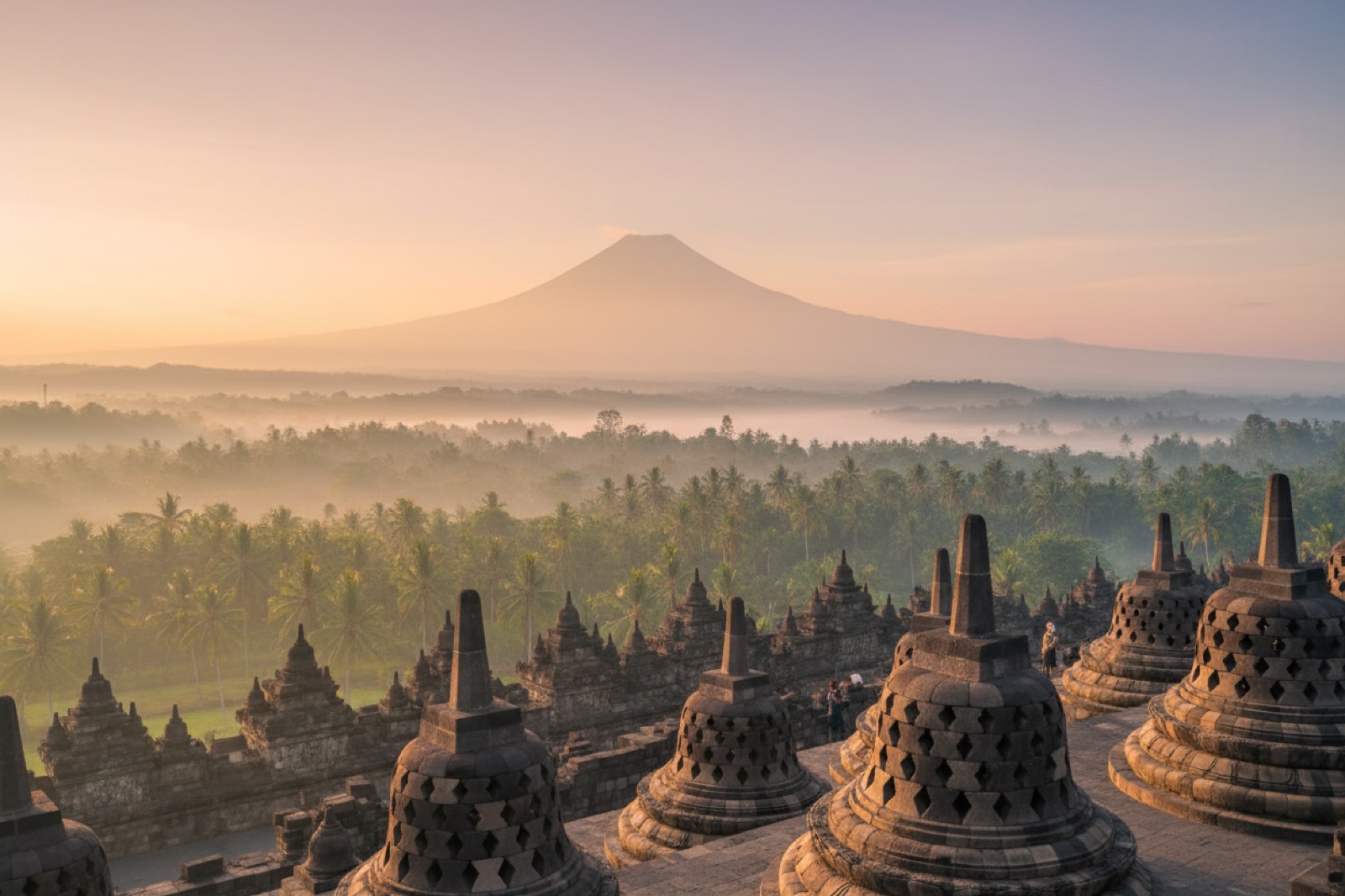
Sunrise at Borobudur, the temples of Prambanan and a sunset cliff, a Mount Merapi jeep tour and the silver old town, plus the Kraton and Malioboro — a practical three-day Yogyakarta plan with Maps links, budgets and the timed-ticket tips.
Yogyakarta is the cultural soul of Java — the world's largest Buddhist monument at Borobudur, the soaring Hindu towers of Prambanan, a living sultan's palace, batik and silver crafts, and a wild volcanic coast. The big sights are spread out, so the plan is to group them by direction and use a car-with-driver for the temple and volcano days.
This three-day route covers Borobudur at sunrise with the royal city, Prambanan with the sunset cliffs, then Mount Merapi, the Kotagede silver workshops and the museum. Borobudur's upper terraces are now timed, capped and ticketed separately — book that slot ahead if you want it. Yogyakarta is also one of Asia's best-value cities for food and boutique stays; every stop links to Google Maps.
At a glance
Your day-by-day Yogyakarta route
A 3-day Yogyakarta route
Borobudur and the Kraton city, then Prambanan and the sunset cliffs, then Mount Merapi, the silver old town and the museum — temples balanced with the volcano, crafts and culture.
The two temples, then a day for the living volcano, the silver old town and the museum — temples balanced with Merapi, crafts and culture.
Day 1Borobudur sunrise, the Kraton & Malioboro
- Borobudur TempleBorobudur
- Gudeg (Jogja jackfruit stew)Citywide
- Bakmi Jawa (Javanese noodles)Citywide
- Malioboro StreetMalioboro
If it rains If Borobudur's sunrise clouds over, the Kraton, Taman Sari's tunnels and Beringharjo market still work; the museum is a dry backup.
Add if you have time A wayang shadow-puppet show at the Sonobudoyo museum.
Day 2Prambanan, sunset cliffs & a city night
- Prambanan TemplePrambanan
- Ratu Boko (sunset palace)Prambanan
- Tebing Breksi (cliff park)Prambanan
- Sate klathak (spoke-skewered goat satay)Bantul / Imogiri
If it rains The cliffs are exposed — do Prambanan early and swap the sunset spots for the museum and an indoor wayang night.
Add if you have time The Prambanan Ramayana ballet (dry-season evenings).
Day 3Mount Merapi, silver crafts & the café quarter
- Mount Merapi jeep lava tourKaliurang
- Kotagede (silver & old town)Kotagede
- Sonobudoyo MuseumCity
- Lesehan street dining (Malioboro)Malioboro
- Prawirotaman (café quarter)Prawirotaman
If it rains If the Merapi jeep tour is rained off or on volcanic hold, spend the morning on Kotagede's silver workshops and the Sonobudoyo museum instead.
Add if you have time A batik or silver class in Kotagede.
Route last checked 2026-06-21 — verify hours and bookings before you go.
Want this as an interactive guide you can reshape by length, budget and pace — with the maps, food and a one-tap PDF?
Get the Yogyakarta Destination Pass · S$16.90 Or build a free planWhere to stay in Yogyakarta
Yogyakarta is excellent value — boutique hotels and pool villas cost a fraction of Bali's. Most visitors base in the centre near Malioboro and the Kraton, or just south in leafy Prawirotaman for cafés and a calmer feel. For a Borobudur sunrise, a night at a Magelang resort near the temple saves the pre-dawn drive. Stay central and day-trip out to the temples, volcano and coast.
Malioboro / Tugu
First-timers — the main street, markets, Kraton and the train station
Prawirotaman
Boutique hotels, cafés and a relaxed traveller scene
Kotagede
A quieter heritage-and-silver old town stay
Near Borobudur (Magelang)
A resort or homestay for a sunrise temple start
By budget
- Budget — S$13–38 · Guesthouses & homestays, Hostels, Budget pool hotels
- Mid-range — S$46–125 · Boutique hotels, Heritage Joglo hotels, Pool villas (great value)
- Comfortable — S$150–500+ · 5-star resorts, Amanjiwo-tier retreats near Borobudur
- A boutique Joglo hotel or pool villa is superb value here — far cheaper than Bali for similar style.
- Stay walkable to Malioboro and the Kraton, then hire a car-with-driver for the temple and coast days.
- For a Borobudur sunrise without the 4am city drive, sleep a night near the temple in Magelang.
Rates and availability change, and Borobudur-area resorts are dearer — confirm with the property or a booking site before paying.
What to budget for Yogyakarta
Per person, per day, excluding flights. A rough guide only — your costs depend on season, area and pace.
Budget
- Accommodation: Guesthouse, homestay or hostel near Malioboro/Prawirotaman (IDR 150,000–450,000).
- Meals: Warungs and street food — gudeg, ayam goreng, angkringan, bakmi jawa, gado-gado (IDR 15,000–50,000/meal).
- Transport: Gojek/Grab and Trans Jogja; becak around the centre.
- Attractions: Borobudur and Prambanan grounds, the cheap Kraton and Taman Sari, Tebing Breksi sunset, Kotagede silver lanes.
- Evening: Malioboro lesehan dinner, Alun-Alun Kidul's lit pedal cars, an angkringan kopi joss.
Mid-range
- Accommodation: Boutique, Joglo or pool-villa hotel (IDR 550,000–1,500,000).
- Meals: Sit-down Javanese — sate klathak, mangut lele, a heritage gudeg — plus the café scene (IDR 50,000–150,000/meal).
- Transport: A car-with-driver for the temple and coast days; Gojek in town.
- Attractions: Add the Borobudur upper terrace, a Merapi jeep tour, the Sonobudoyo wayang night or the Prambanan Ramayana ballet.
- Evening: The Prambanan Ramayana ballet, a wayang shadow-puppet show, a Prawirotaman bar.
Comfortable
- Accommodation: 5-star resort or an Amanjiwo-tier retreat near Borobudur (IDR 1,800,000–6,000,000+).
- Meals: A royal-Javanese fine-dining dinner with gamelan, great coffee and wine (IDR 200,000–700,000+/head).
- Transport: A private car with guide for the whole stay.
- Attractions: Add a private sunrise with breakfast, the Jomblang cave adventure, a batik masterclass and a spa day.
- Evening: A heritage fine-dining dinner with dance, a private Ramayana box, a rooftop cocktail.
When to visit Yogyakarta
Yogyakarta is tropical and hot year-round with two seasons: the dry season (roughly May–Sep) is best for sunrises, the volcano and the caves; the wet season (Oct–Apr) brings heavy afternoon rain and cloudier sunrises. Check a forecast close to your dates and start temple days at dawn.
Dry season (best — clear sunrises) May, Jun, Jul, Aug, Sep
Hot and drier, ~22–32°C, with the clearest skies — ideal for Borobudur sunrises, the Merapi jeep tour and the Jomblang cave light beam.
Front-load outdoor sights in the cool morning; keep the museum, batik workshops and malls for the hot afternoon.
Look out for: Borobudur & Prambanan sunrises at their best, Ramayana Ballet at Prambanan (dry-season nights), Jomblang light beam clearest
Wet season (green, humid, fewer crowds) Oct, Nov, Dec, Jan, Feb, Mar, Apr
Hot and humid, ~23–31°C, with heavy afternoon-to-evening downpours; mornings are often still clear, and the rice fields turn brilliant green.
Do temples and outdoor adventures in the morning before the rain builds; keep the Kraton, museum, batik and malls as afternoon-storm backups.
Look out for: Lush green temple grounds, Lower prices (except late Dec), Galungan/Nyepi affect nearby Bali, not Java
Common Yogyakarta mistakes to avoid
- Trying to do Borobudur and Prambanan in the same short window without travel time — they're an hour apart in opposite directions.
- Expecting to climb Borobudur freely — access to the upper terraces is now timed, ticketed and capped; book the upper-level slot ahead if you want it.
- Underestimating south-coast distances — Timang, Jomblang and the Gunungkidul beaches are 1.5–2 hrs each way; make them a full day.
- Only seeing the temples — the Kraton, Kotagede's silver, the batik workshops and the food are the heart of Jogja.
- Riding a becak without agreeing the price first, or following a 'special batik exhibition' tout — a common gentle scam.
Good to know in Yogyakarta
Getting around
- Gojek/Grab cars and ojek (motorbike taxis) are cheap and quick for in-town hops.
- Hire a car with a driver for the day to group Borobudur, Prambanan, Merapi or the south coast.
- Becak (pedicab) and andong (horse cart) are an atmospheric way around the Kraton and Malioboro — agree the price first.
- Trans Jogja buses run set routes very cheaply with a tap card if you want to go local.
- Trains from Tugu Station reach Jakarta, Surabaya and Bandung scenically — book popular services ahead.
There's no metro. Use Gojek/Grab for cheap cars and motorbike-taxis around town (upfront in-app fares), and hire a car-with-driver for a full temple, Merapi or south-coast day. The Trans Jogja bus co…
Money & connectivity
- Cash (rupiah) rules at markets, street food, becak and small warungs; cards and QRIS e-payments work in hotels, malls and bigger restaurants. Carry small notes. ATMs are widespread in the city.
- Cheap local SIMs/eSIMs (Telkomsel, XL, Indosat) with good 4G in the city and at the main temples; free Wi-Fi in most hotels and cafés.
- Not obligatory but appreciated — round up at restaurants, a small tip for a driver or guide, and a little for the hotel staff. Many cafés add a service charge.
Local etiquette
- The Kraton is a living palace — dress respectfully (cover shoulders and knees) and follow the guides' lead; photography is restricted in some rooms.
- At temples and mosques, dress modestly; at Borobudur you may be asked to wear a provided sarong and use designated paths to protect the stones.
- Yogyakarta is a conservative, devout city — dress modestly away from the beach and be mindful during prayer times and Ramadan.
- Bargain politely and with a smile at the markets and with becak drivers; agree fares before you ride.
Police: 110 · Ambulance: 118 / 119 · Search & Rescue (Basarnas): 115 · Do NOT drink tap water — stick to bottled/filtered. Mount Merapi is active; follow official advisories.
Yogyakarta — frequently asked questions
How many days do you need in Yogyakarta?
3–4 days is the usual recommendation for Yogyakarta. The plan here runs to 3 days, and the full guide builds routes from 1–4 days — so you can shorten or extend it to fit your trip.
What food is Yogyakarta known for?
Yogyakarta's highlights include Gudeg (Jogja jackfruit stew), Sate klathak (spoke-skewered goat satay), Ayam goreng (Javanese fried chicken), Bakmi Jawa (Javanese noodles), Angkringan & kopi joss and more. Each is linked to Google Maps in the route above; famous spots queue at peak times, so go off-peak or pick a neighbouring stall.
Where should I stay in Yogyakarta?
Good bases include Malioboro / Tugu (First-timers — the main street, markets, Kraton and the tra…); Prawirotaman (Boutique hotels, cafés and a relaxed traveller scene); Kotagede (A quieter heritage-and-silver old town stay). See "Where to stay" above for the full breakdown by budget.
How much does Yogyakarta cost per day?
Roughly around S$25–50 a day on a budget, S$55–110 mid-range, S$130–320+ comfortable per person, excluding flights and accommodation swings. See "Budget" above for what each tier covers.
When is the best time to visit Yogyakarta?
Yogyakarta is tropical and hot year-round with two seasons: the dry season (roughly May–Sep) is best for sunrises, the volcano and the caves; the wet season (Oct–Apr) brings heavy afternoon rain and cloudier sunrises. Check a forecast close to your dates and start temple days at dawn. See "When to go" above for the month-by-month detail.
Do I need a visa for Indonesia?
Many nationalities can enter Indonesia on a Visa on Arrival (or e-VOA bought online) for tourism, extendable once; some passports are visa-exempt and others must apply in advance. A passport valid 6+ months and an onward ticket are usually required, and an electronic customs declaration applies. Rules change — confirm your own eligibility on the official Indonesian immigration / e-VOA websites before booking.
Plan Yogyakarta your way
Start free, or get the complete interactive guide — maps, food, day-by-day routes you can reshape, and a one-tap PDF.